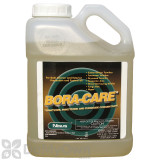
We understand that the Boracare label can be tricky to follow. The text is referring to a gallon of undiluted solution, which makes 2 gallons of finished solution, while the chart is referring to diluted solution. So, one gallon of concentrate makes 2 gallons of finished solution when diluted at a 1:1 ratio, and that total amount of 2 gallons of finished solution covers 1,600 square feet (800 per gallon of dilution).
Bora-Care will penetrate through the wood and kill any insect eating the wood no matter where they are in the wood. However, it can only be applied to raw wood so you would need to apply it to the side that is not painted. It cannot be applied to wood that is painted, stained, or sealed. If your wood is painted, stained, or sealed, then you will need to drill holes and inject Bora-Care or sand the finish off of the wood, treat with Bora-Care, and then refinish the wood
Boracare is a very viscous liquid that needs to be thoroughly mixed with warm -hot water and thinned out before application. The label states that it can be applied by sprayer or by painting or rolling the product on but we are not sure that submerging the wood in the solution will be a proper application as it should only be applied until wet and not to the point of run off or oversaturation.
Boracare cannot be used in misting equipment but could be used in foaming equipment, and we carry a few types. The Foamer Simpson or Chapin Poly Foamer would be able to be used along with a foaming concentrate like the ProFoam. Once foamed it will only penetrate the wood that it touches, so be sure applications are made directly in areas that contact infested wood or wood you are wanting to protect. If foaming wall voids would not contact the wood you need to treat you will need to drill into the wood and inject following the instructions on the product label.
Bora-Care can be applied in any temperature as long as it is not below freezing. However, the warmer the temperature the easier it will be to mix and apply the Bora-Care because of its thick consistency.
Bora-Care should only be applied to raw, natural wood. For more information on treating for powderpost beetles, please take a few moments to review our treatment article for successful eradication.
Bora-Care should only be applied to raw wood. It will not penetrate through any wood that has been pre-treated. Polyurethane is equivalent to applying paint, so the best process would indeed to be strip the finish and apply Boracare as this is the only product that will penetrate through the wood and eliminate the existing infestation and prevent future infestations.
The insulation should be removed so that the Bora-Care can be applied directly to the wood. It is safe to place back once surfaces treated are completely dry. You can foam Bora-Care into the wall voids. The insulation may soak up a bit of the applications but here is how the pros handle it: You will need to use a stud finder to locate each stud. You should then drill a hole at the top of the wall on either side of each stud and you should drill a second set of holes at the bottom of the wall on either side of each stud. You will apply the foam using the top holes and you will know the foam has successfully coated the wood when it comes out of the bottom holes on either side of the studs.
No, Boracare will not affect the romex wiring when applied to raw wood. The rate is 1:1 for an active infestation.
Bora-Care can be mixed with an impeller-type mixer that would be used with an electric drill.
Yes, the logs should be dry before applying Bora-Care.
It is best to apply Bora-Care to wood that is free from dust or other debris.
Bora-Care is only available in the gallon size. Unfortunatly it does not come in any smaller quatities.
Bora-Care will only penetrate the wood it is applied to. For floor that is stained you will either have to pull it up and treat the unfinished underside or sand down the top to the raw wood and apply.
You need to be very careful about using any kind of termiticide around a body of water that contains fish or other aquatic life since most termiticides could harm the fish. If you are removing the infested pieces of wood, then you may not need any other treatment for active termites. Something you can do is to use a wood treatment on the new wood and any other raw wood on the bridge and/or the pergola. Boracare can be used on raw wood, then once the Boracare is dry, you would want to use a water sealant to protect the treatment. Be sure that you apply the Boracare away from the water so there is no runoff, overspray, etc. into the water.
Bora-Care is safe if it is applied to raw wood when the pets are not present. Once the treated surfaces have completely, it is safe for them to returned to the treated areas/surfaces.
Ideally we would need to know specifically what pest you are treating for. Are you treating for powder post beetles? Or are you treating for drywood termites? In most cases if a wood destroying insect is found within the frame of a piece of furniture your options are as follows: Option 1- Strip down any stain or finish on the wood down to its raw natural state and apply a product like Boracare to the raw wood surface to treat it and then you can refinish as desired once dry; Option 2- If stripping the finish off isnt an option then you would need to drill holes in the needed places of the furniture and insert a product like Jecta which is an injectable form of Boracare. Both the Boracare and Jecta absorb into the wood so that as the insects inside it eat the treated wood they consume it and die from it. Both products also last for the life of the wood to protect it; Option 3- If neither of those are an option for you and you dont want to drill holes or remove the finish, then your only option would be to hire a company that has a heat treatment or fumigation treatment chamber to put the furniture within to kill all the insects within it without doing any damage to the couch.
We arent sure we understand what you mean. Boracare is meant to be mixed with water and applied with either a hand pump sprayer that you create the pressure with yourself and spray on until wet but not dripping, or applied with a paint brush or roller. For large beams you would need to be applying it in one of those options and doing two coats to all sides if the beams are more than 5 inches thick in each direction.