

Save! Get 6 for only $40.00 each
Have a Question? Ask Our Pros!
Average Rating
There are no reviews for this product yet. Be the first.
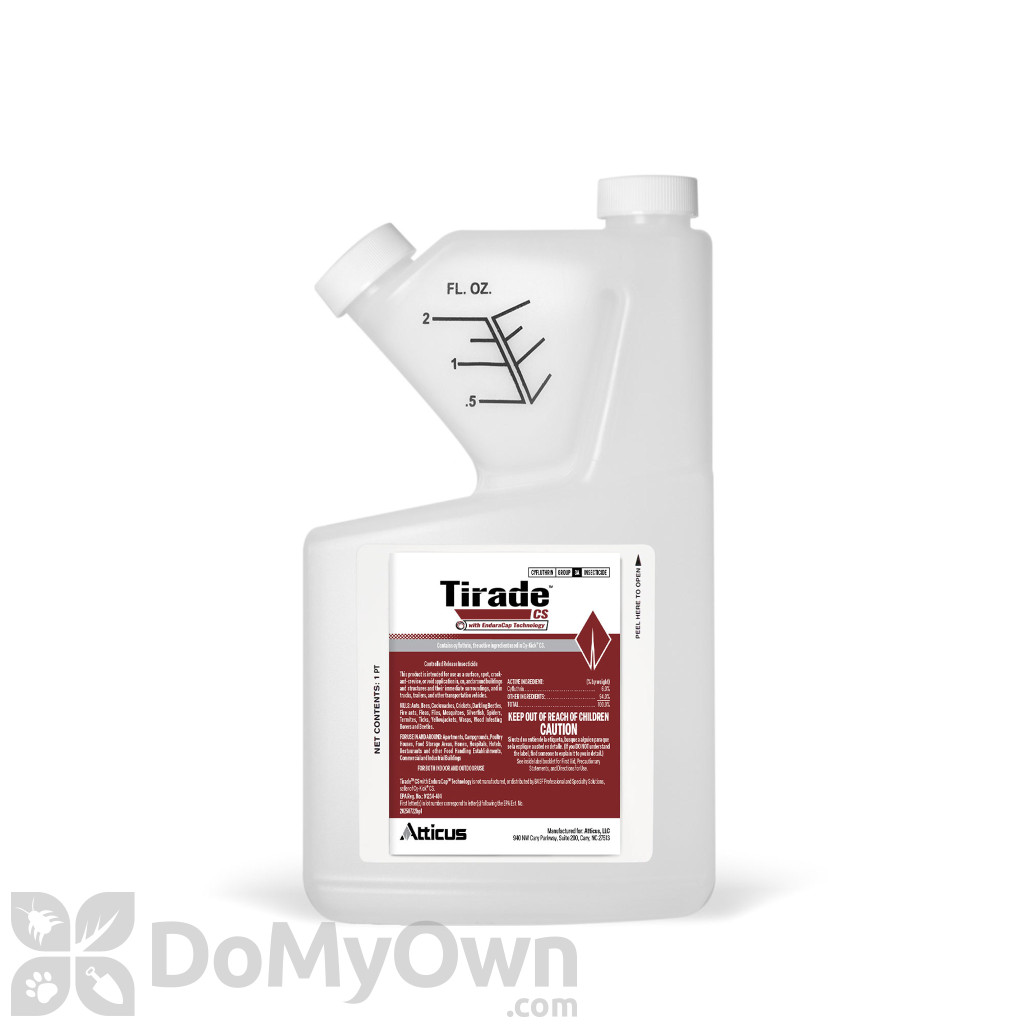
Tirade CS with EnduraCap Technology Insecticide is a professional-grade, controlled-release insecticide formulated with cyfluthrin for broad-spectrum control of crawling and flying insects. The capsule suspension formulation uses EnduraCap Technology to deliver up to 90 days of extended residual activity by protecting the active ingredient and enabling controlled release over time.
Tirade CS is commonly used to manage pests such as ants, cockroaches, bed bugs, fleas, flies, mosquitoes, spiders, ticks, and stinging insects including wasps and yellowjackets. The formulation adheres well to both porous and non-porous surfaces, making it effective for surface applications, crack-and-crevice treatments, void injections, and perimeter treatments when applied according to label directions.
Tirade CS is labeled for use in and around residential, commercial, institutional, and industrial structures, including food handling establishments, livestock housing, and transportation equipment. It may be applied indoors or outdoors using a variety of application methods to support routine pest management, clean-out treatments, and preventative perimeter programs.
Product Documents
| Active Ingredient | Cyfluthrin - 6.0% |
|---|---|
| Target pests | Ants, Bed bugs, Cockroaches, Crickets, Fleas, Flies, Mosquitoes, Silverfish, Spiders, Ticks, Termites, Wasps, Yellowjackets, Carpenter ants, Carpenter bees, Centipedes, Earwigs, Scorpions *See Label For Full Details. |
| For use in |
Homes Apartments Commercial buildings Industrial buildings Food handling establishments Hospitals Hotels and motels Livestock housing Transportation equipment *See Label For Full Details. |
| Application | Dilution Rate: 1-2 oz. per gallon of water. Surface application, Crack-and-crevice application, Void injection, Spot treatment, Perimeter treatment, Foam application. *See Label For Full Details. |
| Pet safe | Yes, if used as directed on label. |
| Yield | One pint yields approximately 8 to 16 gallons of finished spray solution when mixed at labeled application rates. Total yield of diluted solution varies by target pest, application site, application method, and carrier volume selected. *See Label For Full Details. |
| Formulation |
Professional-grade Group 3A Insecticide |
| NOT FOR SALE TO |
AK, CA, DC, HI, NH, PR CT (Restricted To Licensed Applicators Only) |
| Coverage Area | One pint treats approximately 8,000 to 16,000 square feet depending on application rate and target pest. *See Label For Full Details. |
| Color | Opaque off-white |
| Shipping Weight | 1.11 lbs |
| Manufacturer | Atticus LLC (Mfg. Number: 530089) |
| UPC | 810117114565 |
| EPA Registration | 91234-404 |
Ants, Asian lady beetles, bed bugs, bees, boxelder bugs, cadelles, carpenter ants, carpenter bees, carpet beetles, centipedes, chocolate moths, cigarette beetles, clover mites, cluster flies, cockroaches, crickets, darkling beetles, dermestids, drugstore beetles, earwigs, elm leaf beetles, fire ants, firebrats, fleas, flies, flour beetles, grain weevils, grasshoppers, hide beetles, hornets, Indian meal moths, larder beetles, lesser grain borers, lesser mealworms, loopers, Mediterranean flour moths, merchant grain beetles, mealworms, millipedes, mosquitoes, psocids, rice weevils, sawtoothed grain beetles, scorpions, silverfish, sowbugs, spiders, springtails, termites, ticks, warehouse moths, wasps, wood wasps, wood infesting borers and beetles.
*See label for full details.*See label for full details.
Tirade CS with EnduraCap Technology Insecticide may be applied indoors and outdoors as a surface spray, spot treatment, crack-and-crevice application, void injection, or perimeter treatment. Applications are made using diluted spray solutions at 0.05% to 0.10% concentrations depending on target pest and infestation level.
Surface applications are applied as a coarse wet spray to adequately cover treated areas without runoff. Crack-and-crevice and void applications should be made using equipment designed to deliver insecticide into harborage areas while limiting dripping and runoff. Perimeter treatments may be applied as a band around structures and to entry points such as doors, windows, eaves, and foundations.
Applications should not be made during rainfall and treated surfaces must be allowed to dry before reentry by people or pets. Repeat treatments may be made as needed, but not more than twice per week and at least three days apart.
Always read and follow the product label for complete directions, restrictions, and precautions.
Tirade CS with EnduraCap Technology Insecticide is labeled for outdoor yellowjacket control using a baiting method when prepared and applied according to label directions. This approach targets foraging yellowjackets and is intended for use around structures, yards, recreational areas, and other outdoor locations where yellowjackets are a problem.
Bait Preparation
To prepare the bait, measure 100 grams of a meat-based bait material and mix it thoroughly with 2 grams of Tirade CS concentrate. Mix only the amount of bait needed for immediate use, as prepared bait can lose attractiveness over time. Do not exceed the labeled amount of insecticide in the bait mixture, as excessive concentrations may cause yellowjackets to avoid the bait.
The bait should have a moist, workable consistency. If the bait becomes dry during preparation, add a small amount of water to restore moisture before placing it into dispensers.
Bait Selection
Yellowjacket bait preferences vary depending on season and colony development. Protein-based baits are generally most effective. Suitable bait options include: fish-based canned pet food, cooked fresh meat or fish with excess grease removed, canned meat products, canned fish products, and deli meats. When possible, reduce bait particles to small pieces to improve handling and feeding by yellowjackets.
To improve results, bait preference may be tested by placing small amounts of different bait types near areas of yellowjacket activity and observing which bait attracts the most foragers before preparing treated bait.
Bait Dispenser Setup
Place prepared bait into dispensers until the bait level reaches approximately halfway between the bottom of the container and the access openings. Dispensers should be constructed from non-food containers with multiple entry holes that allow yellowjackets to enter but limit access by other animals.
Clearly label each dispenser to indicate it contains bait mixed with Tirade CS insecticide. Do not reuse bait dispensers for any other purpose.
Placement and Distribution
Hang bait dispensers around the perimeter of the area being protected, rather than clustering them in one location. Dispensers should be placed in sunny areas where yellowjackets are active and hung at heights that are inaccessible to children and pets.
For best coverage, place 3 to 4 dispensers per acre, or space dispensers approximately 100 feet apart. Because meat-based bait may attract wildlife, secure dispensers firmly so they cannot be easily removed, shaken, or consumed by animals. Attaching dispensers at two points is recommended to reduce movement.
Bait Maintenance and Reapplication
Inspect dispensers regularly while yellowjackets remain active. Replenish bait with fresh material as needed, especially during warm weather. Bait may become unattractive after several days, particularly when temperatures exceed 90°F.
If possible, gently stir the bait once per day before peak yellowjacket activity to expose fresh bait material. Continue replenishment until yellowjacket activity has ceased. If yellowjackets reappear later in the season, retreat the area using fresh bait.
Dispose of any unused or stale bait properly. Do not reuse old bait or dispensers.
Important Yellowjacket Baiting Notes:
Use only outdoors
Do not place dispensers where food is prepared or consumed
Prevent access by children, pets, and wildlife
Follow all label directions for mixing, placement, and disposal
Always read and follow the product label for complete directions, restrictions, and precautions.
There are no reviews for this product yet. Be the first.
There are no questions for this product yet. Ask the first.