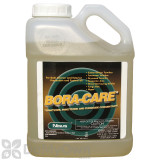
Yes, Bora-Care can be used on the damaged stud or new stud. It can be used on any exposed studs as a preventative and curative treatment, at a 1:1 ratio. You can treat all the wood, as long as it's bare and as long as nothing will tamper with the treated wood.
Bora-Care is a borate-based product so slight contact with skin would not be absorbed or harmful and washing off with soap and water when contact is made would be recommended wear safety gear to prevent contact.
Bora-Care can be used on raw, untreated wood surfaces indoors and is safe for kids and pets once dry.
Once applied to bare wood, Bora-Care will last the lifetime of the wood. Please read the product label for complete application instructions.
Yes, you can apply an oil or water based stain to treated wood 48 hours after an application of Bora-Care.
You may apply Bora-Care once premise 2 has dried.
You could use a product called Boracare on the barrels but you would be required to seal the inside of the wine barrel after application. The red/white wine stain will not affect the application, only if it were stained with an actual wood stain or sealant.
Boracare could be used on the underside of the bed where it is not stained. It is safe when used as directed on the product label. Since you are treating a baby bed we would recommend not using the bed until the product has completely dried, about 48 hours. After that time it will be safe to use the bed again. Bora-Care is a very safe product once dry and it is considered a green product as well.
The only way to get Boracare into a wall void would be to use it as a foam. You will need to use a foaming agent and a poly foamer. The mixing ratio is 2:1, meaning 2 parts water to 1 part Boracare. We would recommend using the high expansion formula so there is less moisture. Keep in mind Boracare can only be applied to raw wood.
We would recommend using two gallons of Boracare. This product will generally treat about 500 square feet.
Boracare is not labeled for carpenter bees. A dust, such as Delta Dust, would be an excellent option in the holes. It will make it uninhabitable for the bees to live.
It should be fine to use Bora-Care on the wood as the information we can find on the Spectracide product does not indicate that it penetrates into the wood like the Bora-Care does.
We apologize, but we are not aware of any natural methods, such as freezing, that will kill termites. We recommend either using Boracare on the cabinet if there is no finish or paint on it or using Jecta directly in the kickback holes from the termites.
Please check out our Termite Guide for more tips on how to treat and prevent termites.
Bifen XTS and Dominion 2L should not be mixed for any termite treatments. Neither of these products are a wood treatment product. We do carry Bora-Care for treating wood surfaces. Please take a few moments to review our treatment article on How to Get Rid of Drywood Termites for more information on a successful eradication.
No, Boracare is not labeled for carpenter bees.
For carpenter bees, we would recommend using our Carpenter Bee Kit. It has everything you need to do a complete treatment for bees.
Please also check out our Carpenter Bee Guide for more tips on how to treat and prevent them in the future.
Pets and people need to be kept out of the area while Boracare is being applied. Once the product dries completely, it is safe for them to return. Boracare is not labeled for use on trees. We would recommend using a general insecticide, such as Suspend SC, on your trees for ants. This can be used every 30 days as needed.