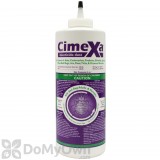
Cimexa Dust can be used as either a liquid or dry form. For the liquid form, you will mix 1 lb. of product with 1 gallon of clean water. This will treat approximately 1000 square feet. Approximately 1 qt of solution will treat 250 square feet. The dry form will likely give you more coverage than the liquid form will. You should still only apply Cimexa Dust as a crack and crevice treatment as directed on the product label. Please see our Bed Bug Treatment Guide for more tips and information.
CimeXa Dust is safe for pets when applied as directed on the product label. We would recommend only applying CimeXa Dust in cracks and crevices where it cannot be moved around easily and, thus, exposed to pets. If the dust is visible, then the excess dust should be picked up using a moist paper towel. If you are trying to protect from or check for bed bugs, then we would suggest traps such as the Climb-Up Insect Interceptors used under the bed legs.
CimeXa Insecticide Dust kills bedbug adults and nymphs (hatched from dusted eggs). For more information on treating bedbugs, please take a few moments to review our treatment article on How to Get Rid of Bedbugs for a successful eradication program.
You can return to an area treated with CimeXa Insecticide Dust after it has settled, typically after 30 minutes to an hour when the product is applied as directed on the label.
When treating for bed bugs with CimeXa Insecticide Dust, it should be used in the dust form. The label states the following:
Remove bedding and take the bed apart. Treat the interior framework, joints and cracks in the bed frame. Treat the mattress and box spring, paying particular attention to tufts, folds and edges, and the interior framework of the box spring. Remove wall-mounted head boards and treat the back side. Treat picture frames, moldings, hollow furniture legs, cracks and crevices, along baseboards, and any areas with visible signs of infestation, including rugs and carpet. Treat upholstered furniture by removing or lifting (if possible) the cushions and treating the undersurface. Treat the interior framework, cracks and joints of the furniture, and the folds, tufts and edges of cushions and other upholstered areas. Do not treat toys and stuffed animals with product. Treat wall voids by removing electrical switch plate covers to allow access, but don’t apply dust directly in electrical boxes. Apply about ¼ oz of dust to each accessible void.
The label also states that when using it as a liquid application, the product does not dissolve in water and will be left behind and visible after evaporation.
When treating for bedbugs, it takes a combination of products to take care of the problem. Please view our Bedbug Control Kits and our Bedbug Control Guide for great information on treating for bedbugs and the best products for the job.
There really would be no valid reason for mixing Cimexa with Diatomaceous Earth as they are both dusts that would be used in the same areas and will kill the same way. If you do choose to apply them both, you should apply each product according to the instructions on each product label. Be aware that applying too much dust can have a negative effect. If you can see the dust, so can insects and they may avoid the treated area.
An insecticide dust such as CimeXa Insecticide Dust applied with either a hand duster or a Dustin Mizer would be great to use in a drop ceiling area for spiders and other crawling pests. CimeXa will be effective as long as it is present and dry, so it will provide protection long after liquid insecticides will have broken down. Dust is also safe to use where there may be electrical wires in that area. You may also need to check the humidity in the basement area; higher than normal humidity can attract insects which are providing a food source for the spiders. Please see our Spider Treatment Guide for more tips and information.
CimeXa dust can be applied to indoor cracks and crevices and joints of the furniture, and the folds, tufts and edges of cushions and other upholstered areas.
CimeXa Insecticide Dust would only be applied to the cracks of the shelves where it meets the walls and other areas where insects would harbor.
Cimexa Dust should be applied in areas such as wall voids, under and around baseboards, and behind outlet covers, and under sinks. If it is applied according to the instructions on the product label, the fans should not disturb it.
CimeXa Dust is similar to diatomaceous earth in that it is an all-natural product that does not break down over time. However, CimeXa Dust is more finely processed than most DE products, allowing for very low use rates. CimeXa also works as a direct dessicant, meaning the insects only have to contact the dust for a short amount of time rather than actually moving across it, so it does kill a little more quickly than DE. CimeXa Dust will be effective as long as it is present in the treatment area and remains dry.
CimeXa Dust is a dry powdery formulation, so if left out in open areas, then it could potentially move. Insecticide Dust should be used only in cracks and crevices where it is not easily disturbed or moved.
Since CimeXa Insecticide Dust will dry back to powder formulation, it can leave a white residue on darker surfaces. You can wipe and vacuum the residue away.
While CimeXa Insecticide Dust is not labeled for bees, it is not really selective in the insects it kills so can harm bees if they contact a treated area long enough to pick up the product and be effected.
Per the product label of CimeXa Insecticide Dust it can cause moderate eye irritation in humans and domestic animals. We would have to say that this would include birds as well. We would recommend removing their cages during the application, and until the dust completely settles in the room. The residual of the product would be perfectly safe provided they did not come in direct contact with it.
We do not suggest allowing any dust contact the records to avoid damage. We do offer Nuvan ProStrips that most folks will use for pictures, papers, books, music cds, dvds, electronics etc. It is not guaranteed that the treated crates will reach the bedbugs that could be potentially inside the sleeves.
Cimexa Dust is labeled for carpet beetles when applied as directed on the label and can kill the adults and larvae that contact the treated area. If you have already applied a DE dust we would not recommend applying another dust in the same area for several months as too much dust can make insects avoid treated areas.
Please take a few moments to review our article about How To Treat Carpet Beetles for more tips and information.CimeXa Insecticide Dust can be applied to voided areas and cracks and crevices. We recommend that you insulate first and then treat with a dust applicator so the dust does not get disturbed during the insulation installment process.