Buy 2 or more: $19.61 each
Have a Question? Ask Our Pros!
Average Rating
There are no reviews for this product yet. Be the first.
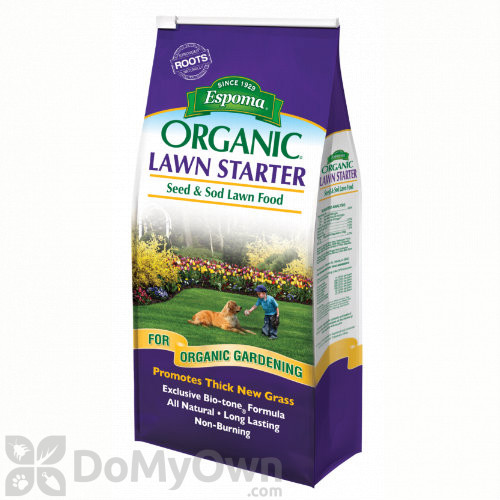
The Espoma Organic Lawn Starter 3-6-3 is a high-quality lawn food that helps establish new lawns. It contains higher phosphorus compared to other lawn foods resulting in a stronger root system and thicker grass. This specially formulated fertilizer is derived from organic and natural ingredients without added fillers or sludges. It works by gradually breaking down its vital nutrients, providing a safe food supply that can last the entire growing season. Best applied when starting to grow grasses from sod, seed or plugs, or when over-seeding existing turf. The product comes in a granulated form for easy spreading. Available in 7.5 lb. bag.
Product Documents
| Active Ingredient | Total Nitrogen - 3.0% Available Phosphate - 6.0% Soluble Potash 3.0% Calcium - 4.0% |
|---|---|
| For use in | For use on newly seeded and sodded areas. |
| Application | Apply at a rate of 12 lbs. per 1000 sq. ft. Use spreader settings according to label or spreader manufacturer recommendations. |
| Pet safe | Yes, if used as directed on label. |
| Formulation | Granules. |
| Shelf Life | 5 Years |
| Dimensions | 11 in. x 4 in. x 7 in. |
| Special Features | Safe for kids, pets and the environment. Enhanced with Bio-tone Microbes. |
| Shipping Weight | 7.25 lbs |
| Manufacturer | The Espoma Company (Mfg. Number: LS7) |
| UPC | 050197059077 |
Also contains non-plant food ingredients.
Contains a total of 624 Colony Forming Units (CFU) per gram of the following species:
Derived from: Bone Meal, Pasteurized Poultry Manure, and Sulfate of Potash Magnesia.
1.9% Slow Release Nitrogen from Bone Meal and Pasteurized Poultry Manure.
Apply at a rate of 12 lbs. per 1000 sq. ft. Use spreader settings below or spreader manufacturer recommendations.
The above spreader settings will vary according to the rate of walk and the mechanical condition of the spreader. Adjustment to the spreader setting may be required to apply the proper amount.
If overseeding an existing lawn, cut the grass first. Then apply Espoma Organic Lawn Starter with a drop or broadcast spreader and be certain to overlap slightly for best coverage. After seeding or sod installation water and keep the area moist with light frequent watering until the new grass has been cut twice. After that time resume normal watering.
Apply when seeding a new lawn, over seeding an existing lawn, or starting turf from sod or plugs. Local regulations may restrict the timing of fertilizer applications to lawns.
There are no reviews for this product yet. Be the first.
There are no questions for this product yet. Ask the first.