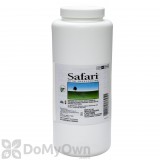
Safari 20SG Systemic Insecticide with Dinotefuran can be used for bagworms at the following rates:
Field Grown (In-Ground) Trees (Less than 24” diameter at breast height) 3-12 grams (1.25-5.0 level teaspoons) per inch of trunk diameter at breast height (DBH) 1.05-4.2 ounces per 10 inches of trunk diameter at breast height (DBH) For multi-stem trees, base rate on cumulative inches of diameter of all stems at breast height.
Field Grown (In-Ground) Trees (24” diameter or greater at breast height) 6-12 grams (2.5-5.0 level teaspoons) per inch of trunk diameter at breast height (DBH) 2.1-4.2 ounces per 10 inches of trunk diameter at breast height (DBH) For multi-stem trees, base rate on cumulative inches of diameter of all stems at breast height.
Apply in enough water to wet the lower 12” of trunk and surrounding soil sur- face. Apply in a one foot wide band over base of trunk and soil down cen- ter of hedgerow. To improve performance, rake back mulch before application.
After applying Safari 20SG Systemic Insecticide with Dinotefuran, you will generally see results within 1-2 weeks depending on how severe the disease is/was.
Safari 20SG Systemic Insecticide with Dinotefuran will typically last between 6 months to 1 year. Please keep in mind that there are many variables that can influence how long a systemic is still active in the target plant such as soil condition, rainfall, and health of the plant.
Yes, for a basal trunk spray, Safari 20SG Systemic Insecticide with Dinotefuran can be used at a rate of 12 oz per gallon of water.
Safari 20SG Systemic Insecticide with Dinotefuran would be applied at the rate 1.25 - 2.5 level teaspoons) per foot of height when applying as a soil drench. Mix required dose in water and uniformly apply to soil around base of shrub or tree. Pull back mulch before drenching. Apply 1 - 4 pints of drench solution per foot of height (shrubs).
Safari 20 SG Insecticide is a systemic product and will be taken up by the root system and translocated upward throughout the plant. When applied as a foliar spray, the product offers translaminar and locally systemic control of foliar pests.
For Armored and Soft Scale and treatment of small areas: Mix 1/2 - 1.0 tsp per gallon. You will want to apply this product when wind drifts are minimal.
Make first application just before pest populations reach an economic threshold. If necessary, make a second application after 14 - 21 days. Tank mixing with a surfactant may improve control of pests such as whitefly, mealybug and scale. Confirm plant safety of tank mix in small area before using on a commercial scale.
Yes Safari 20SG Systemic Insecticide with Dinotefuran can be used as a basal bark treatment for certain soft scale insects. According to page 13 of the product label: 12-24 oz per gallon Depending on bark type and thickness, one gallon of spray solution will typically cover 65-85” of cumulative trunk diameter (1.5-2.0 fl oz per inch of trunk diameter) when applied to trunk between soil surface and 4-5 feet above soil surface.
The 3-lb. jug of Safari 20SG Systemic Insecticide with Dinotefuran contains 48 ounces of product.
Per the product label, you can mix Safari 20SG with a surfactant, but it may not be very helpful for woolly adelgids for example since they are mostly controlled by ingesting the active ingredient rather than by contact: Tank mixing with a surfactant may improve control of pests such as whitefly, mealybug and scale. Confirm plant safety of tank mix in small area before using on a commercial scale.
You will need 1 tsp. of Safari 20SG Systemic Insecticde with Dinotefuran per gallon of water to treat for aphids and whitefiles. However, this product is not labeled for use on residential house plants. If you have residential outdoor house plants, you would can use a product like Dominion 2L . You would use 0.45 mL per gallon of water for a foliar spray. You can also use Bonide Systemic Granules Insect Control, which is labeled for all houseplants, both indoors and outdoors. You will need to use 2.5 tbsp. per gallon of water.
Yes, you can use Safari 20SG Systemic Insecticide with Dinotefuran as a foliar spray and systemic drench. As a drench you can use 0.2 to 0.4 oz per 1,000 sq ft, as a systemic drench you can use 3 to 6 grams per foot of height with sufficient water; please follow the label instructions. We also recommend using two different products, you could use Safari 20SG for your systemic drench application and something like Talstar P for a foliar application using 0.5 to 1 oz per 1,000 sq.ft.
Time applications of Safari 20SG Systemic Insecticide with Dinotefuran to coincide with when most vulnerable pest life stage is present on plants (Majority of pests would be Spring time). Do not apply to wet bark, during rainfall, or if rain is expected within 12 hours. Control may be less effective in trees with thick bark, and at times when trees are not actively growing or transpiring.
If you follow this link and scroll to page 10 of the Safari 20SG Systemic Insecticide Product Label , it has a chart and instructions for use in containerized plants. It goes over potted plants by size in inches rather than gallons so you will want to measure your plants and reference the chart for how much solution for your needs. Please let us know if you have any other questions and we would be happy to help.
You would use 12 - 24 oz of Safari 20SG Systemic Insecticide with Dinotefuran per gallon depending on bark type and thickness, one gallon of spray solution will typically cover 65 - 85” of cumulative trunk diameter (1.5 - 2.0 fl oz per inch of trunk diameter) when applied to trunk between soil surface and 4.5 feet above soil surface. Spray bark on root flare (buttress roots) and on trunk between soil surface and 4-5 feet above the soil surface. Adjust nozzle to uniformly distribute spray over the entire circumference of the tree trunk and buttress roots. Wet bark just to the point of saturation and run off onto soil. Apply ONLY with a low volume sprayer operated at less than 20 PSI to prevent tree damage, bounce back and drift of spray droplets. Time applications to coincide with when most vulnerable pest life stage is present on plants. Do not apply to wet bark, during rainfall or if rain is expected within 12 hours. Control may be less effective in trees with thick bark, and at times when trees are not actively growing or transpiring.