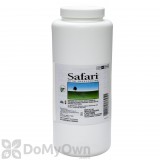
We apologize, but we are not able to determine if that amount of Safari 20SG Systemic Insecticide with Dinotefuran is correct without knowing for sure what the height or diameter of the tree(s) being treated is.
When using Sefari 20SG Systemic Insecticide with Dinotefuran to treat for whiteflies on leafy vegetables you want to use it at a ratio of .16 - .25 fl oz per 1000 sq ft of coverage area. Please let us know if we can be of any further assistance.
When using Safari 20SG Systemic Insecticide with Dinotefuran to treat for oystershell scale you would want to treat when they are the most vulnerable. The most vulnerable life stage called a crawler is active from late May through early June. Please refer to the product label for the correct usage rates for your specific pest.
Safari 20SG Systemic Insecticide with Dinotefuran can be applied to ornamental plants at 1.25 - 2.5 level tsps per foot of height.
Safari 20SG Systemic Insecticide with Dinotefuran is not mixed to get a 20% solution. It contains 20% Dinotefuran so there are no instructions for applying at that percentage. The rate when mixed will be lower and depends on what you are treating for and what you are treating on and is not percentage based. Please refer to the product label for complete instructions for your need.
We understand the different rate directions can be confusing on the Safari 20SG. You should get great results from using the higher rate under the product label directions for use on hedges. Since your hedges are in a row and so close together, some of the active ingredient from each plant's root system would reach over to the neighboring plants. So you could use the rate of 1 oz per foot of hedge height per 100 linear feet rate, which would put you at 4 oz for 100 linear feet of shrubs which is 4 feet high.
Yes Safari 20SG Systemic Insecticide is labeled to kill bagworms.
Yes, you can use an imidicloprid product such as Dominion 2L insecticide as a soil drench around the root system of the tree while the tree is actively growing. This is typically done in the late winter/ early spring. You would use 0.1 – 0.4 oz of Dominion 2L per inch of trunk diameter at breast height diluted in water in a bucket or watering can and poured around the base of each tree. We generally recommend that you pair a soil drench with a topical spray such as a horticultural oil or a pyrethroid such as Talstar P. The contact sprays are most effective when applied to the crawlers that have emerged and are active in mid to late summer. You can also then spray the trunk with Safari.
Since Safari 20SG is not labeled for use on maple trees that are tapped for syrup, we would not recommend this application. Usually you will need to wait at least one year from treatment to harvest edibles that have been treated with a systemic insecticide. We recommend contacting Valent directly at 800-898-2536.
You will use 2.1-4.2 ounces of Safari 20SG Systemic Insecticide with Dinotefuran per 10 inches of trunk diameter at breast height (DBH) For multi-stem trees, base rate on cumulative inches of diameter of all stems at breast height. Apply in enough water to wet the lower 12” of trunk and surrounding soil surface. Mix required dose in water and uniformly apply to soil around base of shrub or tree. Pull back mulch before drenching. Apply 1-4 pints of drench solution per foot of height (shrubs) or inch of trunk diameter (trees). Adjust drench volume based on soil type, soil moisture and thickness of mulch so that product is moved into root zone. To enhance soil penetration in heavy soils and sloping terrain, dig shallow holes around tree or shrub, and apply drench solution in holes. Lower drench volumes may be less effective in dry soils or when applied over heavy mulch unless there is adequate rainfall or irrigation after application to move product into root zone.
You could potentially mix Safari 20SG Insecticide with another product such as a bifenthrin insecticide if you are applying it as a foliar spray. However, usually if a systemic product like Safari is used with another product, the Safari would be applied as a soil drench or bark banding treatment. Then you could apply the bifenthrin product as a foliar spray so you are using 2 different treatment methods.
Per the product label, you should use higher labeled rates of Safari 20SG Systemic Insecticide with Dinotefuran for broadleaf evergreens with dense foliage (ex. hollies), on very large trees or if controlling insects on woody plants more than on herbaceous plants.
For Pine Needle Scale, apply at the rate of 3g to 12g (1.25 tsp to 5 tsp) per inch of trunk diameter at D.B.H in 1-4 pints of water per inch of trunk diameter at D.B.H. One (1) level teaspoon contains 2.4 grams, and 1 cup (8 fl oz) contains 4.0 oz by weight
Safari 20SG Systemic Insecticide with Dinotefuran is applied at 0.5 to 1 tsp per gallon of water for foliar spray applications to small treatment areas. For soil drench applications to the root zone, the recommended rate is 3 to 6 grams (1.25 - 2.5 level teaspoons) per foot of shrub height in 16 to 64 ounces of water per foot of shrub height.
Water volume is determined by the soil conditions and how much water is needed to evenly cover the root zone from the trunk to the canopy.
Safari can be applied as a basal trunk spray as gives instructions on page 15 of product label for doing so.
Per the product label, you can mix Safari 20SG with a surfactant, but it may not be very helpful for woolly adelgids in particular since they are mostly controlled by ingesting the active ingredient rather than by contact:
Tank mixing with a surfactant may improve control of pests such as whitefly, mealybug and scale. Confirm plant safety of tank mix in small area before using on a commercial scale.