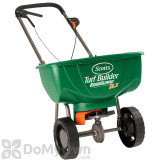
Scotts Turf Builder EdgeGuard DLX Broadcast Spreader - Questions & Answers

Displaying 1 to 3 (of 3 questions)
Sort:
  • Asked by Nancy from Fayetteville, Nc
    07/07/2022
    Q
    What setting for spreading tifblair centipede see?
    A
    Tifblair centipede seed should be applied at a rate of 1 lb. per 2,000 - 4,000 sq. ft. Almost all fertilizers, herbicides, insecticides, etc have treatments in amounts of so much product per 1000 square feet.  So if you can figure out what your walking speed is then you know anytime you apply any product that calls for so much of it per 1000 square feet, you always set your spreader on this setting.  You can calibrate this by marking off a 1000 square foot (10 x 100) area and placing 1.4 pounds of any type of product of similar granule size, or of the merit itself in the spreader.  Start with a low setting and start walking your marked off area at a normal pace.  You can adjust as you go and find the basic setting for you to apply the product over a 1000 square feet. 
    Was this answer helpful to you?   Yes No
  • Asked by Joan from Sweet Home Tx
    03/18/2023
    Q
    The wheel fell off, and the whole spreading mechanism came apart too. Need some DIY video to put back together
    A

    We are sorry to hear you are having trouble with your Scotts Turf Builder EdgeGuard DLX Broadcast Spreader. We suggest contacting Scotts directly for assistance at  1-888-270-3714.

    Was this answer helpful to you?   Yes No
  • Asked by David from Albert Lea Mn
    04/17/2023
    Q
    I have a scotts dlx spreader What setting should I use to spread Barenburg Pro bluegass seed1-2 lbs per 1000"
    A

    Unfortunately, we do not have the spreader settings for that specific combo, and since the manufacturer does not list that spreader on their bag we are unsure what the exact setting would be. Due to the thousands of granules on the market and just as many different types of spreaders, there isn't a master list that exists. You may want to try calling the manufacturer of your spreader or the chemical itself directly, to see if anyone on their staff has that info. Otherwise, you will want to calibrate your spreader to the product you are using and its application rates. You can see a short video on how to accomplish this below.

    How to Calibrate your Spreader: https://www.youtube.com/watch?v=9vXBjeVA3ao&list=PLG-iVFWQzYnkrUznseZ-SDTcWgflq8DDo&index=39

    Was this answer helpful to you?   Yes No
Displaying 1 to 3 (of 3 questions)