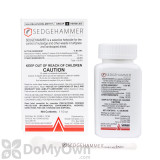
The shelf life of SedgeHammer Herbicide is about 5 – 7 years. We recommend to keep it stored in a cool, dry place, out of extreme temperatures.
You will need 1 scoop of SedgeHammer Herbicide per gallon of water. Please refer to the product label for complete application instructions.
SedgeHammer Herbicide - 1.33 oz. bottle is pet safe when used as directed on the manufacturer's product label. Pets should be removed from the area while the product is being applied. Once the treated area has completely dried, it is then safe for pets to re-enter the area.
No, SedgeHammer Herbicide is not labeled for skunkvine therefore would not be recommended.
Skunkvine is a dificult vine to treat and there are not really any selective herbicides specifcally labeld for it. Eliminating skunkvine will require multiple applications using a non selective herbicide like Roundup QuickPRO while the vines are connected to the root system in the ground.
Alternative herbicide active ingredients known for eliminating skunkvine after multiple treatments would be products using triclopyr and/or imazapyr. These herbicides will remain in the soil for long periods of time therefore should not be used where future seeding or planting will take place.
Please contact your County Cooperative Extension Office for their recommendations for treating Skunkvine in your county.

SedgeHammer Herbicide - 1.33 oz. bottle should have a shelf life of between 5 – 7 years, if it is stored in a temperature stable environment, and away from any direct sunlight.
SedgeHammer Herbicide - 1.33 oz. bottle has a shelf life of between 5-7 years, if stored in a temperature stable environment, away from any direct sunlight.
SedgeHammer Herbicide has a shelf life of about 5 – 7 years if kept out of extreme temperatures and direct sunlight. Nothing below freezing or above 90. Typically it is best kept in a cool dry place inside.
The Sedgehammer 1.33 oz bottle makes 40 gallons of mixed solution and will cover 40k sq ft. If you are treating smaller areas, the SedgeHammer Plus Herbicide comes in individual 13.5 gram packets and already contains the surfactant. Mix 1 x 13.5 gram packet per gallon of water per 1000 sq ft.
Sedgehammer is safe for use on Bahiagrass as long as you are following the instructions on the product label. If you have any concerns about the use of this product specifically on Argentine Bahiagrass, you may contact the manufacturer (Gowan) directly at (928) 783-8844 for more information.
As long as the correct rate of 0.9 grams in 1 - 2 gal. of water per 1000 sq. ft. is adhered to, Sedgehammer Herbicide - 1.33 oz. can be applied with any standard hand-held or backpack sprayer. However, keep in mind that your specific backpack sprayer / mist blower unit may not be intended for use with herbicides, and may not disperse the product at the labeled rates.
No, SedgeHammer Herbicide cannot be used in hayfields or pastures where there are grazing animals. Unfortunately, there are not any nutsedge control products that we are aware of that can be used in a pastures, hayfields or grazing areas.
You will need to wait 2 weeks following an application of SedgeHammer Herbicide to overseed with annual or perennial ryegrass or bermudagrass.
If applying Sedgehammer after overseeding or reseeding new turfgrass, allow the turf to develop a good root system and stand before making an application. We recommend watiting until after the 2nd mowing before applying Sedgehammer for post emergent weed control.
Please view the full product label for more information.
For one gallon of mixed solution of SedgeHammer Herbicide - 1.33 oz. bottle, add 2 tsp (1/3 fluid ounce) of a nonionic surfactant for best results in treating targeted weeds, per the label.
Typically you would not apply a pre emergent and a post emergent at the same time, since the times of year for each to work best are opposite from each other. Sedge is typically better controlled by spot treatments rather than broadcast applications, and Sedgehammer requires the use a surfactant whereas Prodiamine does not. Prodiamine is also usually applied with a higher water volume per square footage since you want to water it in to create a wall-like barrier in the soil for prevention.