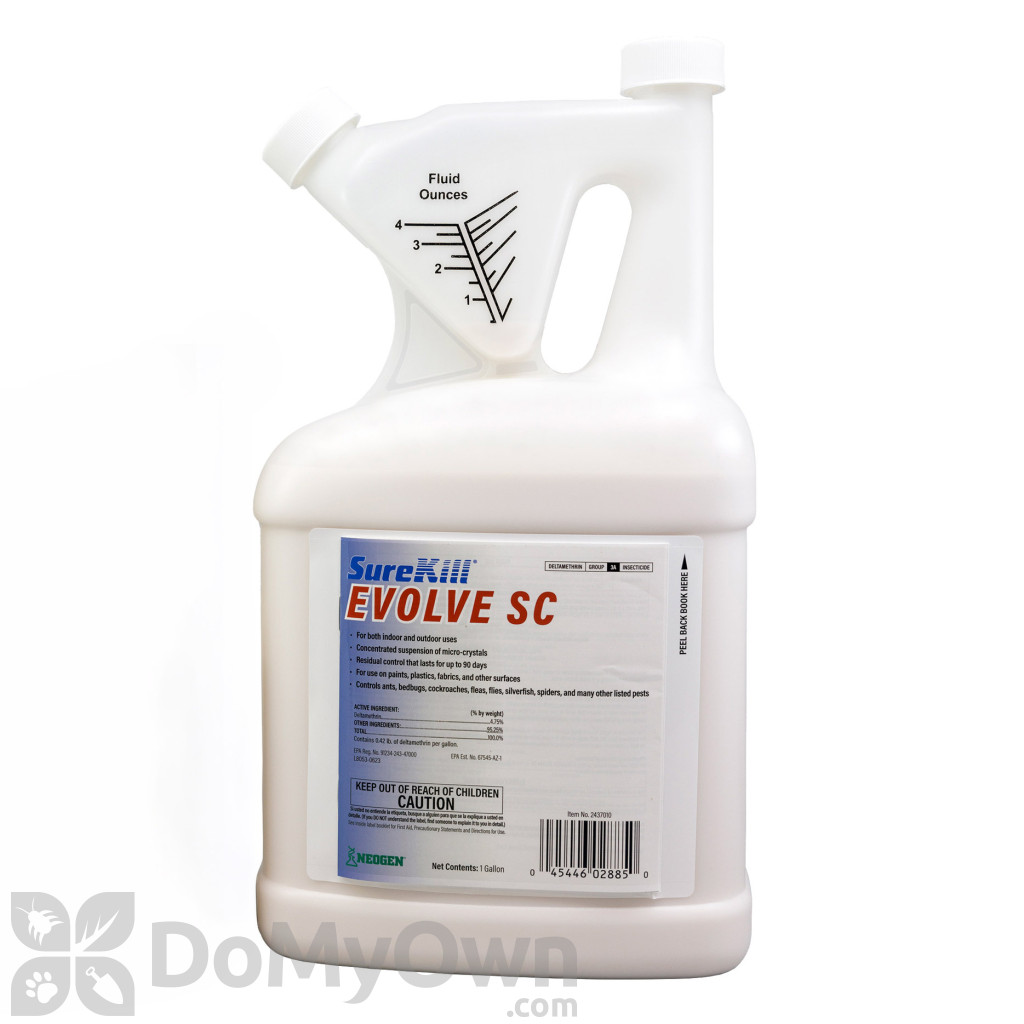
SureKill Evolve SC Insecticide is a professional-grade suspension concentrate formulated with deltamethrin for effective knockdown and long residual control of a wide range of structural pests. Its micro-crystal formulation allows the active ingredient to remain evenly suspended, delivering consistent coverage on treated surfaces when applied according to label directions.
SureKill Evolve SC is labeled for both indoor and outdoor use and may be applied in residential, commercial, and industrial settings. It is designed for crack and crevice, spot, void, perimeter, and residual surface applications, making it a versatile option for routine maintenance treatments as well as clean-out situations where longer residual activity is desired.
This formulation is suitable for use on a variety of surfaces including painted surfaces, plastics, fabrics, and other non-porous materials. With flexible dilution rates, SureKill Evolve SC can be tailored to match infestation severity while supporting rotation programs for resistance management.
Residential Buildings: Apartment buildings, houses, hotels, nursing homes
Food Handling and Processing Facilities: Bakeries, bottling facilities, breweries, candy plants, canneries, dairy product processing plants, food manufacturing plants, food processing plants, food service establishments, granaries and grain mills, kitchens, meat, poultry and egg processing and packaging plants, restaurants, wineries
Commercial and Institutional Buildings: Hospitals, laboratories, mausoleums, offices, schools
Industrial and Storage Facilities: Industrial buildings, installations, warehouses
Transportation and Mobile Sites: Aircraft (cargo only), buses, mobile homes, motor homes, railcars, ships and vessels, trailers, trucks
Full Application Instructions
SureKill Evolve SC is a suspension concentrate that must be diluted with water prior to application. Mix thoroughly and maintain agitation during use to ensure uniform dispersion of the active ingredient.
Dilution rates range from 0.25 to 1.5 fl oz per gallon of water, producing finished spray concentrations ranging from 0.002% to 0.06% active ingredient, depending on the target pest and treatment site.
For outdoor perimeter treatments, labeled rates include 0.25 to 1.0 oz per 1,000 square feet based on pest pressure and application needs. Refer to the label dilution tables for complete tank-mix and coverage calculations. Application rates vary by pest and site. Always follow the product label for full directions.
Apply as a crack and crevice, spot, surface, perimeter, or void treatment in areas where pests are active or likely to harbor. Treat structural surfaces such as walls, floors, ceilings, cabinets, baseboards, plumbing areas, around sinks, behind and beneath appliances, around floor drains, and at entry points including windows, doors, vents, utility penetrations, and eaves. Void applications may be made into wall voids, block voids, structural voids, beneath slabs, stoops, porches, chimney bases, rubble foundations, and crawlspaces.
For flea and tick control, apply as a spot treatment to floors, carpets, rugs, and floor coverings. Do not treat entire floor areas.
SureKill Evolve SC may also be applied to established landscape ornamentals. Apply as a finished spray to ensure thorough coverage of plant surfaces without runoff.