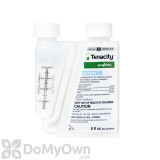
Post-emergent herbicides like Tenacity Herbicide work best when the plant is young and actively growing. Since that is what you are currently seeing, now would be a good time for the first application.
The Tenacity product label suggests the product be applied with any non-ionic surfactant.
No, the bleached seeds that were treated with Tenacity are no longer viable. It may require more than one application for this.
Tenacity Herbicide is a great option for post emergent control of nimblewill. However it is not safe for use in Zoysiagrass and is only for use on St Augustine when used in sod farm. You could use the Tenacity as a spot treatment only for nimblewill as we would not recommend using it as a broadcast spray on your lawn.
Since quackgrass is not on the label to be controlled by the Tenacity, we cannot recommend you use it for this application. We do, however, carry Certainty, which is a selective post-emergent herbicide like Tenacity, that does have Quackgrass listed on the label under weeds controlled. You can see the dilutions and what grasses are tolerant of Certainty on the product label.
Tenacity Herbicide should be used or discarded within 24 hours once it has been mixed with water.
Tenacity Herbicide should be applied at grass seeding or close to seeding for best results. If you are not close, meaning within a week of application, then you would need to wait 6-8 weeks to re-seed.
If you are planning to add any type of groundcover like mulch or pine straw, it is always best to put down your pre-emergent and water it in before applying the groundcover. In this situation, however, we would not recommend using Tenacity Herbicide next to or under desirable trees or ornamental plants. Per the product label, " Avoid over-spray or drift of spray applications onto ornamentals or flower beds and gardens. Roses and daylilies are sensitive plant species. Avoid applications over the top of exposed roots of trees and ornamentals." Our most popular pre-emergent herbicide for use around established ornamental plants is Snapshot.
Tenacity Herbicide and QuinKill Max have different active ingredients and different modes of action. QuinKill contains quinclorac, which is a post-emergent herbicide targeting primarily grassy weeds like crabgrass. Tenacity can be a pre-emergent or a post-emergent, depending on the application and the target weeds. There is a complete list of action on the product label. If you are overseeding with fescue, then you can apply Tenacity at or as close to seeding as possible, except for fine fescue seedings. Avoid applications to newly emerged seedlings until established (4 weeks or after the second mowing, whichever is longer). Please refer to the product label for complete application instructions.
Tenacity Herbicide should be applied when temperatures are between 65-85 degrees. We suggest making an early morning or late evening application if temperatures in your area exceed 85 degrees during the day.
Tenacity Herbicide can be used at the time of seeding for most grass types. Fine fescue is the only grass seed that should not be used at the time of application. It is recommended that you wait 2-4 weeks after an application of Tenacity Herbicide to reseed with fine fescue.
Yes, Tenacity Herbicide is labeled to control Pennsylvania Smartweed.
It is recommended that you do not mow 2 days before or 2 days after the application of Tenacity Herbicide.
Tenacity Herbicide states on the product label: Avoid applications over the top of exposed roots of trees and ornamentals. Just about all herbicides are going to have the restriction that applications should be kept out of the dripline of desirable trees. The best you could do is carefully spot treat the weeds themselves and not broadcast in these areas.
After using Tenacity Herbicide you can triple rinse the sprayer or use a spray tank cleaner to ensure no residual is left.
If you have multiple sprayers, then the best thing for you to do is to calibrate your equipment using just water over a small area. For example, you can mark off an area that is 1000 sq ft (20 x 50 feet), fill your tank with 1-2 gallons of water, and then walk at your normal pace and see how much water you used to cover that area. It is most important that you use the correct amount of herbicide for the size area you are treating and think of the water as the carrier, rather than insisting on a specific amount of product per gallon of water. If you take this time to calibrate your sprayer once, then you will know how much water you use for the area going forward. Using a spray indicator dye is also a great tool so that you apply herbicides evenly over your yard.

You can apply Tenacity anytime before seeding up to the same time that you seed. If you are applying Tenacity as a post-emergent herbicide, then it is usually best to do that application first and wait for the treated plants to die so you can remove any excess dead plant matter before you overseed the lawn. Tenacity will not interfere with seed germination of turfgrasses listed as tolerant on the product label.
Yes, Tenacity Herbicide is labeled for use on Buffalograss.
Since Tenacity Herbicide can be used only on fully dormant Bermudagrass, there is not a time when you would be overseeding and using Tenacity at the same time. You would overseed with Bermuda when the turf is actively growing in spring or summer, if needed at all. So if you applied Tenacity on dormant Bermuda, then it would be long gone by the time the turf is completely green and any seeding would be fone. If you would like to tell us more about the weeds you are targeting, then we can recommend alternate products for your needs.
Tenacity Herbicide cannot be applied around edible vegetation. When applying the product to your lawn, you would want to be sure to avoid over-spray or drift of spray applications onto the fruit trees, and avoid spraying within the drip line of any edible trees.