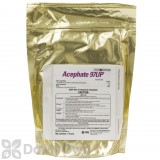
Acephate 97UP Insecticide should not be stored more than 24 hours from mixing. Be sure to agitate it well before each use.
Acephate 97UP Insecticide is not labeled for white pine weevils.
The standard approach to manage white pine weevil is to spray insecticides in spring. This treatment is directed at the overwintered adults to kill them before they lay eggs. Current insecticides useful for this treatment would include products that contain bifenthrin (Talstar), cyfluthrin (Tempo SC Ultra) or permethrin ( Tengard SFR). Rates of use should be to the high-end of what is labeled, such as for bark beetles or borers. Timing is very important but difficult to determine. Sprays should be applied shortly before adults begin to feed on the terminal and lay eggs. You can contact your local cooperative extension office and speak to the master gardener on staff who can help you determine the correct timing. Treatment of the top of the tree during midsummer, after adults have emerged from the wilted terminals, can kill weevils as they feed in this site, reducing overall numbers that may cause problems in the subsequent year. Also, as many weevils crawl to the trees in spring, treatment of the lower trunk at the same time spring terminal applications are made may also help kill some of the migrating overwintered insects.
Since the label application instructions for Acephate 97UP recommend full coverage for thrip control on orchids, this is what we would recommend to do as best you are able for the best insect control. You want to get as full coverage as possible and then you can retreat as often as every 14 days.
Acephate 97UP Insecticide should be mixed at approx. 1/2lb per 30 gallons water for bag worms.
According to the manufacturer, there is no time frame you have to wait to plant any vegetable or vegetable bed in areas where Acephate 97UP Insecticide was applied.
Acephate 97UP Insecticide is not labeled for use on sweet corn.
When using Acephate 97UP Insecticide, you would want to use .27 oz per 1000 sq ft in at least 2 gallons of water to treat for beetles.
While Acephate 97UP Insecticide is labeled to control many pests, spiders are not among them. We would suggest a more general insecticide such as Onslaught Insecticide for spiders and other pests on ornamentals.
Per the manufacturer, Acephate 97UP Insecticide has a half life in soil of approximately 1 week.
For aphids, Acephate 97UP Insecticide is applied at the rate of 0.5lb to 1lb per 50-100 gallons of water. This breaks down to 2/3 tsp to 1-1/3 tsp.per gallon of water. Repeat applications at the low rate should be done a 3 day intervals and for applications at the higher rate, repeat applicaitons every 7 days.
Please refer to the bottom chart for Decidious Trees on page 17 of the product label for more information.
There is a Small Spray Equipment Chart located on page 16 for reference also.
You would use 8oz (1/2lb) of Acephate 97UP Insecticide per 100 gallons, which breaks down to 0.08 oz per gal of water, which is about 2 grams or 1/2teaspoon. If you only have a few plants, then you may want to consider Bonide Systemic Insect Control, which has the same active ingredient but its easier to measure for smaller applications on roses for thrip control.
Acephate 97UP Insecticide is labeled for the bean leaf beetle and the elm leaf beetle, however the snowball bush is highly susceptible to the viburnum leaf beetle. We would recommend Captain Jack's Dead Bug Brew as this product is labeled for all leaf eating beetles.
Per the Acephate 97UP Insecticide product label, you would apply 8 oz of Acephate per acre in 10-50 gallons of water. Please read the full application instructions for horn worms in tobacco on page 14 of the product label.
After spraying Acephate 97UP Insecticide, it should not have damaged your azalea but if you applied it during high temperatures, it could have burned the leaves. The only thing we can recommend is to keep watering and give it time.
Acephate 97UP Insecticide should not be used on flowering plants like hibiscus plants. We would recommend using a product like Talstar P to treat hibiscus for grasshoppers.
We would first have to know what is causing the black mildew on the Crepe Myrtles. The substance you are seeing could be from insects or a fungus therefore, we would recommend contacting your local Cooperative Extension Office in your county for obtaining a positive id of what is causing the black mildew.
We apologize that Acephate 97UP Insecticide is not labeled for use in irrigation systems.
Yes, Acephate 97UP Insecticide is absorbed by plant roots as a drench and foliage when sprayed directly