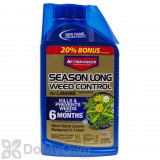
Once your application of Bayer Advanced Season Long Weed Control For Lawns Concentrate is completely dry, it is safe for people and pets to return to the treated area. Dry time usually ranges between 1 and 3 hours, depending on your weather conditions.
It is best not to mow 2 days before applying Bio Advanced Season Long Weed Control For Lawns Concentrate and according to the product label, you should not mow for 1-2 days after an application.
It can take up to 14 days to start seeing results after application of Bio Advanced Season Long Weed Control For Lawns Concentrate. For hard-to-kill weeds you can retreat in 2 weeks if necessary.
Bayer Advanced Season Long Weed Control For Lawns Concentrate does have a pre-emergent in it and will control weeds before they germinate, however it does not control or prevent crabgrass. We would recommend one of our other pre emergent items like Hi Yield with Dimension or Prodiamine 65 for a pre emergent to prevent crabgrass in the spring.
Per the manufacturer, Bio Advanced Season Long Weed Control For Lawns Concentrate can be watered after the product has had enough time to dry but preferably within 24 hours after a post-emergent application. To activate the preventative weed barrier. you can water within 1 hour to 2 days after your application.
For best results, Bio Advanced Season Long Weed Control for Lawns should be applied when weeds are actively growing and temperatures are between 65-85 degrees.
According to the label of Bayer Advanced Season Long Weed Control for Lawns Concentrate for hard-to-kill weeds you can retreat in 2 weeks if necessary. It also states that the maximum application rate of the product is 6.4 oz per 1,000 sq. ft. per application per site. The maximum number of broadcast applications per treatment site is 2 per year.
The mix rate for Bio Advanced Season Long Weed Control For Lawns Concentrate varies on the type of turfgrass you have. If you are not sure of the turfgrass type, we recommend contacting your County Cooperative Extension office for assistance in identifying your turfgrass.
For Cool/Warm Season Turfgrasses such as Bermudagrass, Buffalograss, Fescue, Kentucky Bluegrass, Perennial Ryegrass, Zoysiagrass: The mix rate is 3.2 fl. oz. (6 1/2 TBS) in 2 gallons of water treats 500 sq. ft.
For Bahiagrass, Centipedegrass, St. Augustinegrass Turfgrasses (not for use on improved varieties of St. Augustinegrass, such as Floratam) or mixtures containing one or more of these grasses, the mix rate is 1.6 fl. oz (3 1/4 TBS) in 2 gallons of water treats 500 sq. ft
Bayer Advanced Season Long Weed Control For Lawns Concentrate is meant to be used on lawns only to control broadleaf weeds. You should apply in a way to avoid spray drift from contacting desirable plants. If you just apply around an area where the young trees are but do not make contact with the leaves, it should not harm them.
Bio Advanced Season Long Weed Control For Lawns Concentrate is only labeled for use in established home lawns. It is not labeled to be used on hostas.
Since Bayer Advanced Season Long Weed Control For Lawns Concentrate contains a pre-emergent it can inhibit seed germination of grass as well. It states on the product label that bare spots may be reseeded 60 days after application so the same would apply for overseeding.
does not require the use of a surfactant.
Ferti-Lome Broadleaf Weed Control with Gallery or any other containing the active ingredient Isoxaben, would work for preemergent control of Chamber bitter and can be used in Bahia grass.
You would need to wait at least one year after applying Bio Advanced Season Long Weed Control For Lawns Concentrate in an area to plant a pecan tree.
Bio Advanced Season Long Weed Control For Lawns Concentrate is only labeled for use on lawns. It is not meant to be used in ornamental beds. We do carry a great pre-emergent called Snapshot 2.5 TG and it's to prevent weeds and annual grasses in ornamental beds. There really is nothing for post-emergence control for broadleaf weeds though unless you spot treat with something like Roundup QuickPro for anything that has already emerged. For grasses, an over the top could be used depending on the plants.