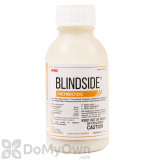
It is recommended to apply Blindside at temperatures less than 85 degrees.
Yes, Blindside Herbicide WDG can be applied to a Bermuda lawn to control spurge. You should apply this product in the morning or later in the evening when temperatures are cooler; usually below 85 degrees is safest for your turfgrass. You should avoid spraying in a manner that would allow direct spray or overspray onto the roots or other parts of desirable trees.
Blindside Herbicide WDG would be a good alternative product to Celsius WG Herbicide. Please check the product label for the weeds you are targeting.
Blindside Herbicide WDG is rainfast 24 hrs after the application has dried.
We do carry Blindside Herbicide that is a selective post-emergent to eradicate henbit in Zoysia, Bermunda and St. Augustine grasses. You can also apply Dimension 2EW Herbicide prior to the weeds germinating for a pre-emergent control. Please refer to the product label for complete mixing and application instructions for each product.
Yes, Blindside Herbicide would be safe to apply in a lawn with centipede grass.
Blindside Herbicide WDG is labeled for use on St. Augustine grass, and the label does not exclude any specific cultivars. If there is discoloration after applying Blindside, established turf will generally recover well. As with all herbicides, you should not apply to turf that is under stress from extreme heat, drought, disease, or other similar situations. It is recommended to apply Blindside at temperatures less than 85 degrees.
Per the label instructions, you can use .15 - .23 oz / per 1000 sq feet of Blindside Herbicide WDG for warm season turf. So for example, at the highest rate of .23 / 1000 sq ft, and you are using 2 gallons of water to cover 1000 sq ft, in your 20 gallon sprayer you would use 2.3 oz and it would cover 10,000 sq ft.
For your 4 gallon sprayer, you will need to calibrate by determining the volume of water required to treat 1,000 sq ft. Use this calibration volume to determine the amount of water and Blindside Herbicide WDG needed to treat the target area. (If using 2 gallons to cover 1,000 sq ft, then at the highest rate of .23 / per 1,000 sq ft, you would use .46 oz of Blindside Herbicide WDG in your 4 gallon sprayer).
You should not use Blindside Herbicide in a manner that would cause it to contact desirable plants like azaleas and hydrangeas either by direct spray or by drift. If you do need to spot treat broadleaf weeds around ornamental flowers or shrubs, it would be better to use a product like glyphosate which does not persist in the soil or have any volatility.
No, Blindside Herbicide WDG cannot be tank mixed with the Atrazine products such as Hi-Yield Atrazine Weed Killer where the product label advises "This product is to be mixed with water only. Combinations with other chemicals in the application mixture are not recommended."
We would not recommend tank mixing Blindside Herbicide WDG with Tenacity as Tenacity requires a surfactant to use and Blindside does not. Plus they are labeled for much of the same weeds so you would only need one or the other. Per the label: USE OF SURFACTANTS: Temporary discoloration of some turf types may result from use of surfactants or adjuvants with Blindside Herbicide. High temperatures and high relative humidity may increase the risk of temporary discoloration.
You should not use Blindside Herbicide in a manner that would cause it to contact desirable plants in flower beds either by direct spray or by drift. You would have to very carefully spot treat the nutsedge only and avoid any contact with the flowers
Per the Blindside Herbicide WDG label: Application to Zoysiagrass in spring transition may result in discoloration. If turf discoloration occurs after an application of Blindside Herbicide turfgrass will generally recover with new growth. Discolored leaf tissue will be removed with mowing.
Blindside is labeled for dollarweed control and should do a good job. The rate for warm season grasses is 0.15 - 0.23 per 1,000 sq. ft. (6.5 - 10 oz. per acre).
Yes, Blindside Herbicide WDG can be applied to established tall fescue safely if used as directed on the product label.
Per the product label: Blindside Herbicide has been found to be compatible with most herbicides, fungicides, insecticides and growth regulators commonly used in turf and ornamental plant management. However, when preparing a new tank mix conduct an appropriate compatibility test by mixing proportional amounts of all spray ingredients in a test vessel (jar) prior to tank mixing with other products. Shake mixture vigorously and allow it to stand for five to ten minutes. Rapid precipitations of the ingredients and failure to re-suspend when shaken indicates that the mixture is incompatible and shoudl not be applied.
If you preform a compatibility test and have no issues then you can mix a liquid fertilizer with it.
Blindside Herbicide WDG can be safely used on Kentucky Bluegrass and Tall Fescue. It could harm any others.
It is recommended to apply Blindside Herbicide WDG when temperatures are less than 80 degress. Discoloration may occur if applied in high temperatures and high relative humidity per the product label.
It is not recommended to use Blindside on a property with a well. According to the product label: The active ingredients in this product are known to leach through soil into groundwater under certain conditions as a result of label use. Use of this chemical in areas where soils are permeable, particularly where the water table is shallow, may result in groundwater contamination.