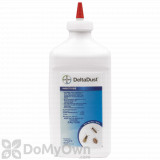
Delta Dust Insecticide is labeled for webbing clothes moths. The product label states: Use DeltaDust as a crack and crevice treatment in closets and other storage areas where these pests are found. This is an adjunct treatment and will NOT control moth larvae already on the clothes. DO NOT apply this product directly to clothing.
Please take a moment to review our Clothes Moth Control Article for additional information on treatments. There are different varieties of Cloths Moths. If you are unsure of what type of moth you have, we recommend contacting your local extension office for a proper I.D.
If left undisturbed Delta Dust Insecticide will remain effective for up to eight months in wall voids.
Yes, Delta Dust can be applied around eaves for wasps and other listed insects. We recommend using a hand duster such as the B&G Bulb Duster 1150 when applying insecticide dusts treat the small cracks, crevices and gaps that stinging insects will use to nest in.
Yes, Delta Dust is labeled for roaches. You will want to apply the product in the areas where roaches typically crawl and hide.
Yes, Delta Dust Insecticide is perfect for underneath and behind appliances like TVs, refrigerators, microwaves etc, as well as in wall voids and cracks and crevices. Of course, you would not want to dust in the open if you have food sitting out on the countertops exposed.
Delta Dust Insecticide is labeled for fruit flies, phorid flies, and sciarid flies.
Delta Dust Insecticide is an insecticide dust only and not a bait. While some insects can pick it up and transfer it to others they are in contact with, it alone will not eliminate a colony/nest unless you are directly dusting it or any holes where insects are coming and going. This process can take a few days or longer depending on the target pest and level of infestation.
The manufacturer recommends wearing safety goggles, chemical-resistant gloves along with long sleeves and long pants when applying Delta Dust.
According to the SDS (safety data sheet) for the Delta Dust in regards to clean up: “Avoid dust formation. Sweep up or vacuum up spillage and collect in suitable container for disposal.” If the dust application is extremely heavy, you may find using a ShopVac is needed as a traditional home vacuum could possibly clog if the application is thick. We recommend wearing a mask to protect against any particles that may fly into the air during cleaning. Wash off any that gets on your skin with soap and water, and toss clothes in a washer when done if chemical drifted on those surfaces.
We reached out to the manufacturer directly for suggestions, and the following information is what they provided. Please see below for best recommendation
Delta Dust Insecticide is effective for targeting bees by dusting the entrance of the nest and the surrounding areas in the evening, when they are less active. Insecticide dust should be applied using a bellow duster or bulb duster.
Yes, Delta Dust Insecticide can be used to kill yellow jackets. You can find helpful tips and information on our article of How to Get Rid of Yellow Jackets.
Yes, Delta Dust can be used to treat cicada killer wasps.
The shelf life of Delta Dust Insecticide is 3 years form purchase date. The delta dust should still be effective, as long as it was properly stored in a dry moderate temperature area.
For cicada killer wasps, it is commonly recommended to use Delta Dust in each individual burrow. Cicada Killer wasps thrive in disturbed environments, such as landscaped yards and places where bare soil is exposed. You can discourage the wasps from nesting in your yard by cutting your grass on the highest setting and by adding a thick layer of mulch to flower beds during the Cicada Killer Wasp season. These wasps do not like over saturated lawns either, so over watering during their season will help prevent them. Unfortunately, there is no fool proof way to prevent cicada killer wasps.
We also like to let our customers know that the Cicada Killer wasps are beneficial insects that provide free pest control for a couple months each year. Cicada killer wasps paralyze and provision their burrows with other insects to feed their young. The beneficial Cicada killer wasps, while large and intimidating to see, are mostly harmless and there have been very few reports of anyone getting stung by just being near them. In most cases where a sting was reported, the wasps were being held or molested in some way. Cicada Killer Wasp stings are also reported to be almost painless.