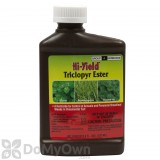
Hi-Yield Triclopyr Ester is only offered in the 8oz container at this time. We apologize for this inconvenience.
Hi-Yield Triclopyr Ester is labeled as safe for use on perennial cool season grasses, including bluegrass, ryegrass, and tall fescue .
Hi-Yield Triclopyr Ester should be used only on well-established turfgrasses. This is usually after at least 4 weeks or the second mowing, whichever is longer. Per the product label: While established grasses are tolerant to this product, newly seeded grasses may be injured until well established (as indicated by vigorous growth, tillering and the development of a secondary root system). Do not reseed treated areas for a minimum of three weeks after treatment.
Hi-Yield Turflon Ester Ultra can be used to control Bermuda grass on certain tolerant grasses.. Per the product label, the application rate is 3/4 fl. oz. of product per gallon of water. You will likely have to do multiple applications to gain full control of the Bermuda grass. Applications can be done every 3-4 weeks.
Hi-Yield Triclopyr Ester could damage nearby desirable trees or plants if it were to contact them or the root system. We would not recommend applying this product at or near the dripline of any desirable trees/plants.
Hi-Yield Turflon Ester Ultra is not labeled for poison oak and would not be recommended to be used for controlling it. The Bonide Poison Ivy and Brush Killer could be used for it.
Hi-Yield Triclopyr Ester can harm bermudagrass, as it is labeled to help supress it in lawns where it is not a desired turfgrass. Monterey Brush and Vine Control is labeled to treat over 50 woody plants and vines and is not labeled to kill grass.
Hi-Yield Triclopyr Ester can be mixed with water as directed and a dye indicator can be added.
Hi-Yield Triclopyr Ester is an oily product that is known to burn lawns therefore the addtion of a surfactant will increase the risk of burning and injuring turf.
Please view the product label for more information.
No, Hi Yield Turflon Ester Ultra is not labeled specifically to eliminate cottonwood trees.
We would recommend using Monterey Brush and Vine Control for cottonwood trees. It is recommended that you use a surfactant with the product so that it coats the plant better and eliminates them.
We want to be clear that Bermuda can be suppressed, but it is VERY difficult to kill completely. It will take multiple treatments to finally kill it. HI-YIELD Turflon Ester Ultra herbicide could be used to do so. Per the product label, the application rate is 3/4 fl. oz. of product per gallon of water for Fescue lawns. You will likely have to do multiple applications to gain full control of the Bermuda grass. Applications can be done every 3-4 weeks.
It would be advised against applying Hi-Yield Triclopyr Ester to the area with bromeliads. They could be harmed by the application as they are not listed as tolerable on the product label.
Yes, Hi-Yield Triclopyr Ester can inure shrubs, trees, flowers and other desirable plants if applied to exposed roots of shallow rooted trees and shrubs.
This product is only labeled to be used on cool season turfgrasses such as Kentucky Bluegrass, Perennial Ryegrass or Tall Fescue lawns as well as ornamental turf.
The mix rate of Hi-Yield Triclopyr Ester is 3/8 - 3/4 oz. per 1 gallon of water per 1,000 sq. ft (16 fl oz to 32 fl oz in no less than 20 gallons of water per acre)
Please be sure to review the product label for more information and complete application instructions before use.
We recommended raking up and cleaning up any dead weeds from the application of Hi-Yield Triclopyr Ester prior to overseeding for best results.
You will need to wait atleast 3 weeks before overseeding or reseeding following the application of Hi-Yield Triclopyr Ester.
Please view the product label for more information.
No, Hi-Yield Triclopyr Ester cannot be used on St Augustine grass.
You can apply either the Hi-Yield Triclopyr Ester or the weed & feed first, it is up to you. You would want to wait 2-3 days between the application of the two products
Hi-Yield Triclopyr Ester will kill the creeping charlie. As far as your grass, that would depend on your grass type. If it is a cool season grass like Fescue, it might discolor it but it should recover. It would not be broadcasted across any warm season turfgrass
The Turflon Ester label does not state any precautionary instructions for roses, but does advise, " Very small quantities of spray, which may not be visible, may seriously injure susceptible plants. Do not spray when wind is blowing toward susceptible crops or ornamental plants that are near enough to be injured. Spray drift can be reduced by keeping the spray boom as low as possible; by using higher volume sprays and lower pressures; using nozzles that deliver larger spray droplets; and by spraying when wind velocity is low."
We recommend contacting your local Master Gardener for help and recommendations on what products to you use and when the best time fram for treatment is to help reverse any damage done.