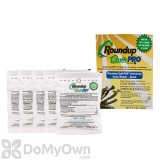
Using a Roundup or stump killer product containing Glyphosate has been successful in killing black bamboo. Please take a look at the following steps below and product recommendations and let us know if you have any questions.
Step 1. Cut the bamboo down to soil level in late winter and wait for new shoots to grow back in late spring/ early summer. Bamboo herbicide won't be effective if the canes of the bamboo are well-developed.
Step 2. Using a shovel, cut off any underground rhizomes when new shoots start to grow back. Break up as many clumps of rhizomes as possible.
Step 3. Apply Roundup QuickPro (Glyphosate) Herbicide to the leaves, stalks, and shoots of the bamboo. Glyphosate herbicide only kills the plants that it comes into direct contact with. This means that you'll need to be careful about applying it only to the bamboo. Most glyphosate herbicides need to be sprayed onto the leaves, stalks, and shoots of the plant and allowed enough time to penetrate before any water dilutes it.
(If you have desirable vegetation surrounding the black bamboo, you can use a paint brush and "paint" the stalks and leaves of the bamboo.)
Step 4. Stump Killer Option: Alternately, use a stump and root killer on the bamboo. Another way to mow down bamboo in its tracks is to cut down the canes and then apply a stump and root killer containing triclopyr to the foliage of any regrowth and to the cut stump.
Hi Yield Triclopyr Ester Ultra
Step 5. Repeat treatment: One application won't eradicate the infestation; bamboo is tough and has a tendency to spread like wildfire. As the bamboo continues to send up shoots, you'll need to continually apply the herbicide treatment to the leaves, stalks, and shoots of the plant in order to properly exterminate it. You should also use this herbicide method in conjunction with rooting out the rhizomes of the bamboo, so that it doesn't keep sending up shoots.
Roundup QuikPRO does come with a surfactant in the formulation. There is no need to add an additional surfactant.
St. Augustine is very sensitive turf species and torpedo grass is very hard to treat. We apologize, but we are not aware of a product that will treat torpedo grass and not harm St. Augustine turf. You may want to consider spot treating with RoundUp and then reseed/resod the treated areas.
Once mixed the shelf life of Round Up Quick Pro is only 24 hours so any mixed solution would need to be used in that time frame for effectiveness and to avoid any issues with clogging or corroding your sprayer.
Roundup QuikPRO is a water-soluble granule.
Unfortunately, we do not have a selective herbicide to kill carpetgrass in another turfgrass. You can use a non-selective herbicide such as RoundUp QuikPro to spot treat the carpetgrass and then reseed or resod as needed in any bare spots.
You will need to wait at least 2 weeks to plant any type of seed after using Roundup QuikPRO - 5 x 1.5 oz. packs.
Yes, Turf Mark Blue can be used with Roundup QuikPRO - 5 x 1.5 oz. packs to make the spray visible when applying
You can use Round Up QuickPro at the highest listed usage rate to help eliminate bamboo. You will be required to cut the bamboo down to a short stump and then apply the Round Up QuickPro. It can take several applications to achieve the desired results.
Unfortunately, there are not a lot of options out there for removing bermuda grass from bahia lawns, as these are very similar grasses. Typically, anything that will kill the bermuda will also harm the bahia. It is usually recommended to spot treat the bermuda as much as possible with a product like Roundup QuikPro, and then replant with bahia in those areas in a couple of weeks when the bermuda is gone.
Unfortunately, most of the herbicides will only suppress the torpedograss for a short time, but will not kill it completely. It is recommended to spot treat the torpedo grass with a non-selective herbicide such as Round Up Quick Pro and then re-seed or re-sod in those areas.