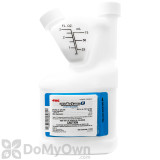
Talstar is not labeled for cankerworms. The most widely recommended product to use for cankerworms is Bacillus thuringiensis, or B.t. A product like Monterey B.t. Insecticide may be a better option for you. There is a great article here on the treatment and prevention of cankerworms.
As long as you follow instructions for each product you can tank mix Talstar P (Talstar One) with a fungicide. Applications to blooms should be avoided.
Talstar P (Talstar One) should be used within 24 hrs of mixing with water and then discarded.
You should use Talstar P (Talstar One) within 24 hours of mixing.
Most insecticides and herbicides are able to be tank mixed together, just make sure you follow each product label instructions for "tank mixing" instructions. You would want to keep kids out of the area while treating, they can return once the are has completely dried
Talstar P is mixed at 1 fl oz (2TBSP) per gallon of water per 1,000 sq ft.
Talstar P should be applied at least 5 feet away from a well.
It should not harm anything to apply Talstar at this rate one time. We recommend that you wait for 30 days outside (90 days inside) to reapply at the rate of 0.5-1 oz per gallon of water.
It is recommended to apply Talstar P monthly for mosquitoes.
Talstar P should be applied 24 hours before rainfall or irrigation. After that point, you can irrigate your lawn on a normal schedule.
As long as you are using the Talstar P at the proper dilution rate in the tank, the metering rate would just be dependent on how quickly you are walking during application. Unfortunatley, we do not carry Stihl blowers so we cannot give you an exact answer. However, we can thell you that with our Solo 451 blower, we suggest a metereing rate of 2 (from a range of 1-4) for a normal pace during application. For most applications, you will mix 0.5-1 oz per gallon per 1,000 sq ft.
Talstar P is gentle on ornamentals, lawns, trees etc if used as directed on establised plants if as directed on product label.
A broad-spectrum insecticide such as Talstar P could potentially kill bees if they are sprayed directly or if they contact the treated areas. For this reason, we do not recommend spraying residual insecticides on flowering plants, and we recommend spraying in the morning or evening when pollinators are less active. There is a product called Mavrik Perimeter which is non-toxic and non-repellent to honey bees once dry. Another option would be to use a repellent such as Mosquito Barrier which is only a repellent once dry.
A mask is not required to apply Talstar P if you are applying in a well-venitlated area. If you are applying in a small, confined space with poor ventilation, you can use something like the N95 Valved Respirator Mask. Please be advised that we are only able to ship within the U.S. at this time.
It is usually recommended to clean a sprayer by triple rinsing with clean water. You can also use a tank cleaner.
Talstar P does not provide an instant knockdown of pests, rather, pests pick up the residual active ingredient by contact. It works by disrupting an insect's nervous system, causing a weakened state followed by death.
When you are using Talstar P (Talstar One) to treat for subsurface insects such as mole crickets, chinch bugs, etc., you will to water in after application per the product label. When applying as pest control product for surface pests, you will wait to water at least 24 hours after application.
In most cases, Talstar P can be mixed with a herbicide as long as the mixing instructions on both product labels are followed. It is recommended to do a small jar test first to be sure that the products are compatible.
When the larva or the moths make contact with areas that have been treated with Talstar P they will be killed by the dry residual. They must contact the treated area for any product to work. Typically a crack and crevice application and lots of cleaning and vacuuming will help eliminate these pests. We actually have a pantry pest kit put together which includes six Pro-Pest Pheronet traps for catching pantry moths, plus a 14 oz. can of D-Force Residual Aerosol with a crevice tool (straw) for spraying in cracks and crevices around shelves and walls to kill pantry pest larvae in harborage areas. You can learn more about pantry moths by reading our Pantry Moth Control Articles.
We would suggest treating the potted plant with Talstar P for ant control. Mix rate would be 0.5 to 1.0 fl oz per gallon of water. You can treat the soil and foliage of the plant.