Buy 2 or more: $837.10 each
Have a Question? Ask Our Pros!
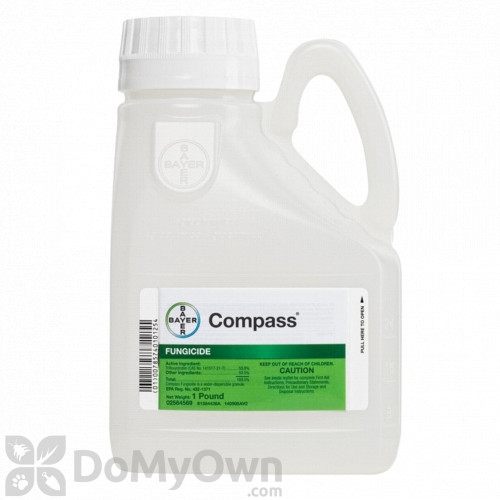
Compass Fungicide is a water-dispersible granular formula that offers long-lasting control of plant diseases in turfgrasses and ornamentals. It contains Trifloxystrobin as its active ingredient which provides reliable protection against disease using low rates. It provides both curative and preventive control with residual activity against listed diseases such as rust, scab, brown patch, leaf spot, anthracnose, summer patch, gray leaf spot, fusarium patch, and pink snow mold. It creates a weather-resistant deposit in waxy coating of the foliage to continuously control diseases. It is also a great tank-mix partner and can be combined with most fungicides, insecticides and other pesticide products. It features reduced-risk compound classification by EPA.
Product Documents
| Active Ingredient | Trifloxystrobin 50.0% |
|---|---|
| Target pests | Rust, Scab, Brown Patch, Leaf Spot, Anthracnose, Summer Patch, Gray Leaf Spot, Rapid Blight, Red Thread, Pink Patch, Fusarium Patch, Pink Snow Mold |
| For use in | Turf-grass: Golf Courses, Lawns,Sod Farms, Parks, Cemeteries, Ornamentals grown in Interiorscapes, Field Nursery Plantings, Forest Nurseries, Landscapes, Greenhouses, Lath and Shadehouses, Containers, and other enclosed structures |
| Application | Begin application of the solution after Compass Fungicide has completely dispersed into the mix water |
| Pet safe | Yes, if used as directed on Label |
| Formulation |
Professional Product Fungicide Group 11 |
| NOT FOR SALE TO |
HI CA, CT (Restricted To Licensed Applicators Only) |
| Special Features | Provides a high-level of control against disease using low use rates |
| Shipping Weight | 1.30 lbs |
| Manufacturer | Envu (Formerly Bayer) (Mfg. Number: 06351867) |
| UPC | (01)0078574010 |
| EPA Registration | 432-1371 |
Compass 50 WG Fungicide is a broad-spectrum preventive and curative fungicide containing 50% trifloxystrobin for long-lasting control of listed foliar, stem, and root diseases in turfgrass and ornamentals. Its water-dispersible formula controls diseases such as brown patch, anthracnose, leaf spot, rust, powdery mildew, summer patch, and pink snow mold while using low application rates.
Compass 50 WG Fungicide controls numerous fungal diseases affecting lawns, turfgrass, and ornamentals, including:
Compass provides suppression rather than complete control of dollar spot. During periods of dollar spot pressure, tank-mix or rotate Compass with Bayleton 50 or another fungicide labeled for dollar spot control.
When conditions favor Pythium blight, Compass must be combined with a fungicide specifically labeled for Pythium control.
Compass 50 WG Fungicide works best as part of a preventive disease-control program. Apply it before visible symptoms develop or when temperature, moisture, and other environmental conditions favor development of the target disease.
Curative applications may be used for certain labeled diseases after symptoms appear. During heavy disease pressure, use the higher labeled rate and shorter application interval. Properly identify the disease before treatment so the appropriate rate and application schedule can be selected.
Disease-specific timing may vary. For example, applications for pink snow mold should be made in late fall before snow cover or in early spring after the snow melts. Do not apply the product over snow.
Compass 50 WG Fungicide can be applied to all major turfgrass species and labeled ornamental plants in locations such as:
The product may be applied only to plants, diseases, and sites listed on the label. Do not apply through an irrigation system or by aerial application.
Compass 50 WG Fungicide application rates generally range from 0.1 to 0.25 oz. per 1,000 square feet, depending on the target disease, disease pressure, and whether the application is preventive or curative.
Apply the measured product in 1 to 2 gallons of water per 1,000 square feet to provide thorough coverage. For soil-borne diseases, use enough water to carry the fungicide into the turf crown and upper root zone.
Common turfgrass rates include:
Rates are determined by the target disease and disease-causing organism, not by the turfgrass species alone. Consult the product label for additional disease-specific rates and tank-mix directions.
Compass 50 WG Fungicide can provide approximately 7 to 21 days of disease protection, depending on the target disease, application rate, site, environmental conditions, and level of disease pressure. Certain label-directed programs allow application intervals of up to 28 days.
Use shorter intervals when disease pressure is heavy or environmental conditions remain favorable for infection. Always follow the disease-specific interval listed on the label.
Prepare only the amount of spray mixture needed for the immediate application. Clean the spray equipment before mixing and maintain agitation throughout the process.
To mix Compass 50 WG granules:
Do not allow the finished mixture to remain in the spray tank overnight. Flush the equipment thoroughly after use and apply the rinsate to a previously treated area according to label directions.
Compass 50 WG Fungicide is compatible with many fungicides, insecticides, and foliar nutrient products. Tank mixing can provide broader-spectrum control, extend disease protection, and help manage fungicide resistance.
When preparing a tank mixture, add products in the following order:
Allow each product to disperse completely before adding the next. Maintain agitation while adding the remaining water and throughout application.
Conduct a jar test for physical compatibility and test the mixture on a small number of plants for phytotoxicity before widespread use. Follow the most restrictive rate, precaution, and limitation on all labels included in the mixture.
Spray additives are not required. Do not use Compass with organosilicate-based additives, as plant injury may occur.
For heavy summer patch pressure, the label directs an initial Bayleton 50 treatment when soil temperatures reach 65°F, followed by a Compass or Compass plus Bayleton program. Follow both product labels and confirm that the combination is permitted at the treatment site.
Application frequency depends on the target disease and treatment site. Turfgrass treatments are generally repeated every 14 to 28 days, while ornamental foliar treatments are commonly repeated every 7 to 14 days.
To reduce the risk of fungicide resistance:
For effective turfgrass disease control:
For the best results, combine fungicide applications with proper mowing, irrigation, fertilization, and other turf-management practices that promote healthy growth.
Apply Compass 50 WG Fungicide after mowing whenever possible. If the lawn must be treated before mowing, allow the application to dry completely before cutting the grass.
Waiting until the treatment has dried helps prevent removal of fungicide from the treated grass blades and allows the product to bind to the plant surface.
Compass 50 WG Fungicide may be applied to labeled ornamentals as either a foliar spray or growing-media drench, depending on the disease.
For most foliar diseases, apply 1 to 4 oz. per 100 gallons of water and spray the foliage thoroughly to the point of drip. Begin before disease is detected or when conditions favor disease development, then repeat every 7 to 14 days until the threat has passed.
Specific ornamental application directions include:
Use the highest labeled rate and shortest interval during heavy disease pressure. Under light pressure, the application interval may be extended as permitted by the label.
Compass 50 WG Fungicide becomes rainfast within approximately two hours after application. For the best results, allow the treatment to dry completely before rainfall or irrigation, especially when treating foliar diseases favored by wet conditions.
For turfgrass, allow the treated area to dry completely before irrigating. When treating soil-borne diseases, use the label-directed spray volume during application to reach the turf crown and upper root zone.
Compass 50 WG Fungicide must not be used for disease control on greenhouse vegetables or vegetable transplants intended for outdoor crop production.
The product is labeled for certain nonbearing stone and pome fruit trees. However, do not apply it to fruit trees that will produce harvestable fruit within 12 months after the final application. Verify that the specific plant and use are listed before treating.
| 5 stars | 1 | |
| 4 stars | 0 | |
| 3 stars | 0 | |
| 2 stars | 0 | |
| 1 star | 0 |

Works very well for Powdery Mildew
By John on 02/07/2025
There are no questions for this product yet. Ask the first.
Compass Fungicide
Rating: 5 (1 Reviews / 0 Q&A)