20%
Off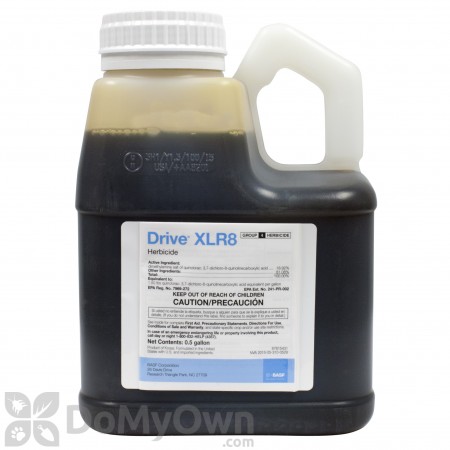
Off
Have a Question? Ask Our Pros!
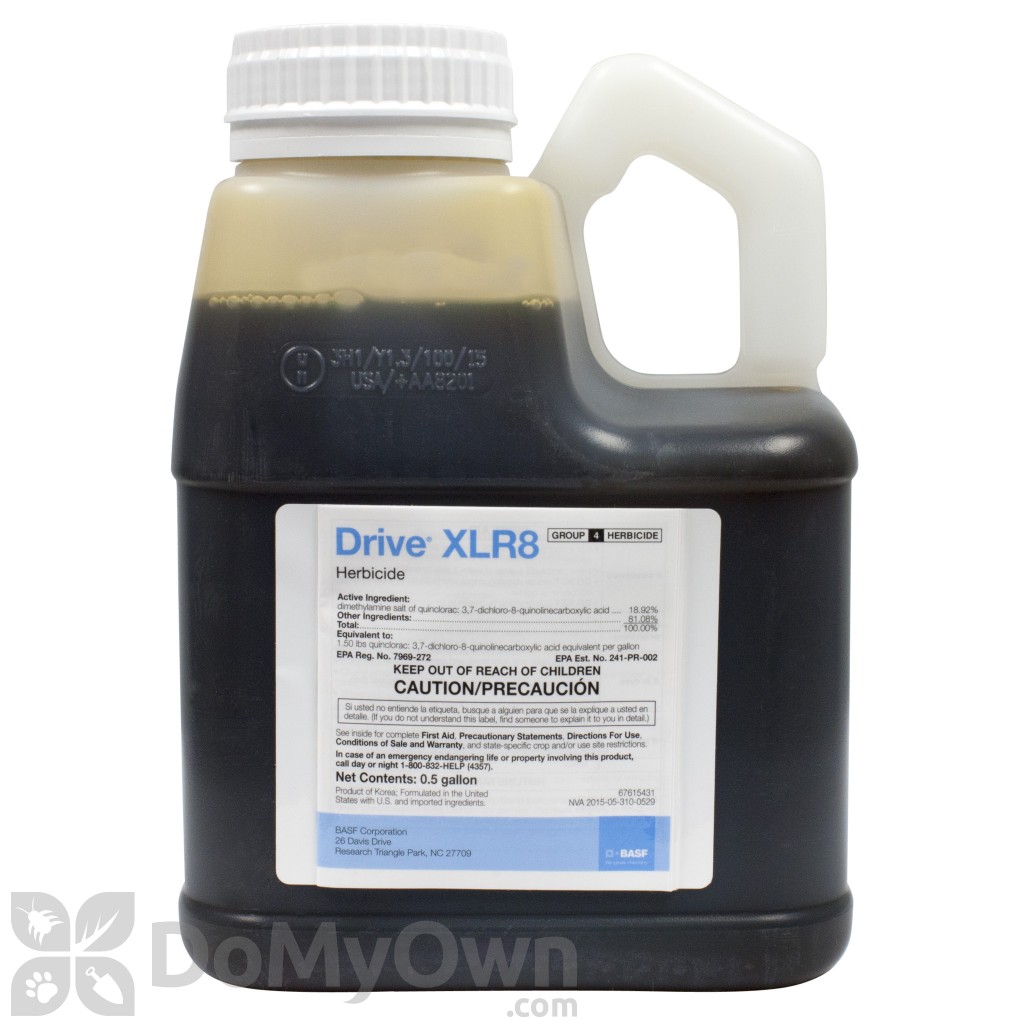
Drive XLR8 Herbicide Crabgrass Killer is a powerful post-emergent herbicide designed to deliver fast and effective control of crabgrass and a wide range of grassy and broadleaf weeds. With a proprietary, water-based Quinclorac formula, this professional-grade crabgrass killer herbicide can be used on residential and commercial lawns, golf courses, athletic fields and more.
Features & Benefits of Drive XLR8 Crabgrass Killer Herbicide:
While Drive XLR8 Herbicide can be used in many warm-season and cool-season turf types, including Bermudagrass, Kentucky Bluegrass, Ryegrass, Zoysiagrass, this post-emergent herbicide should NOT be applied to certain susceptible turf types, including St. Augustinegrass, Centipedegrass, and Bentgrass, or in lawns or turfs where desirable clover is present. See the product label for complete information on turf tolerance.
For optimal results, Drive XLR8 Crabgrass Killer should be applied with a methylated seed oil (MSO), such as Prime Source Duo Stick Select or Dyneamic surfactant. Adding a MSO, an additive you mix in with the herbicide that helps it stick to the leaves so it works better, to the Drive XLR8 mixture increases the absorption of the herbicide mixture into the weed leaves, and helps ensure more even and effective weed control results.
When treating annual grasses such as crabgrass or foxtail, the best control is achieved when Drive XLR8 + MSO is applied when crabgrass is newly emerged (up to the 1-tiller stage), or as they matured (5th tiller stage or greater). In the middle stages of crabgrass growth, the 2-tiller to 4-tiller stage, a follow-up application may be required to gain full control of the crabgrass.
BASF Drive XLR8 provides unsurpassed crabgrass control and improved control of torpedograss, kikuyagrass, foxtail, signalgrass, clover, dandelion, black medic and more. This professional-grade postemergent herbicide can be applied as a broadcast or spot spray and provides up to 30 days residual weed control.
For use in California: Biotypes of large and smooth crabgrass in California have shown varied response to Drive XLR8. If control failure occurs following a full or split application, DO NOT reapply Drive XLR8. Change to a herbicide with a different mode of action.
For smaller jobs consider QuinKill Max Crabgrass and Weed Killer which is available in pints and quarts and contains the same active ingredient quinclorac.
See our Crabgrass Treatment Guide for more information on how to kill crabgrass in your lawn.
Product Documents
| Active Ingredient | Quinclorac 18.92% |
|---|---|
| Target pests |
Barnyardgrass, Bindweed, Crabgrass (large & smooth), Clover, Dandelion, Daisy, Dollarweed, Foxtail, Kikuyugrass, Signalgrass, Speedwell, Torpedograss, and others * See label for complete list |
| For use in |
Bermuda grass, Kentucky bluegrass, Buffalo grass, Fescue, Ryegrass, Zoysiagrass NOT FOR USE ON: St. Augustine, Centipede, Bahiagrass, Bentgrass or Dichondra, Fine fescue unless it is a seed blend |
| Application |
Drive XLR8 Mixing Rate: 0.5 to 1.45 fl oz per 1,000 sq. ft. * Use a Surfactant to Increase Effectiveness * See label for complete application instructions |
| Pet safe | Yes, if used as directed on label |
| Formulation |
Professional Product Group 4 Herbicide |
| NOT FOR SALE TO |
HI CT, NY (Restricted To Licensed Applicators Only) |
| Shipping Weight | 5.06 lbs |
| Manufacturer | BASF (Mfg. Number: 59011404) |
| UPC | 804338114046 |
| EPA Registration | 7969-272 |
Drive XLR8 can be applied post-emergence to residential and nonresidential labeled tolerant turfgrasses to control many broadleaf and grassy weeds in the following sites:
For best results, apply Drive XLR8 when crabgrass is either:
Applications made during the 2–4 tiller stage may require a repeat treatment for complete control. Always refer to the product label for specific application timing, rates, and seasonal guidelines for your region.
For optimal performance:
If crabgrass returns to the same areas each year, consider using a pre-emergent herbicide in early spring and fall to prevent new growth before it starts.
Highly Tolerant:
Moderately Tolerant:
Susceptible:
See label for additional notes on turfgrass tolerance.
How Much Drive XLR8 Do You Mix Per Gallon to Spot Treat Crabgrass?
For spot treating crabgrass, mix:
A surfactant is recommended for the best results, as it helps the herbicide stick to and penetrate crabgrass leaves more effectively. Apply evenly to the target area, ensuring good coverage without runoff. Always follow the product label for complete mixing and application instructions.
What is the mix rate of Drive XLR8 Crabgrass Killer Herbicide to treat 1,000 square feet?
Getting the mixing ratio right for Drive XLR8 Crabgrass Killer is essential to ensure optimal results. Spot treatment applications can be made by mixing and applying 1.45 fl oz of Drive XLR8 Herbicide per 1,000 square feet. Mix with 1 gallon of water and 0.16–0.48 fl oz of MSO. This equates to mixing 3 tablespoons of Drive XLR8 per gallon of water along with 1.5 tablespoons of MSO to treat 1,000 square feet. It is important not to overmix or overtreat the area for optimal results.
Should I use a surfactant or MSO with Drive XLR8 Herbicide?
Yes, it is recommended to mix Drive XLR8 with a methylated seed oil (MSO), such as Prime Source Duo Stick Select or Dyneamic surfactant, before applying to increase the efficacy of the weed control application. By mixing Drive with an MSO, it increases the herbicide's absorption into weeds and helps ensure more even, effective weed control. The Drive XLR8 mixing application rate when doing spot treatments is generally 3 tablespoons of Drive XLR8 Herbicide per gallon, along with 1.5 tablespoons of MSO to treat 1,000 square feet. See the product label for full mixing rates and instructions.
How do I mix Drive XLR8 Herbicide?
In a backpack sprayer, begin with a clean spray tank. Fill the spray tank 1/2 full with clean water and add the required amount of Drive XLR8 to the sprayer. Cap sprayer and agitate to ensure mixing. Uncap the sprayer and add an appropriate amount of methylated seed oil. Cap sprayer and agitate once again. Uncap sprayer and finish filling tank to desired level. During application, agitate the mixture on occasion to ensure mixing. If the mixture is allowed to settle for any period of time, thorough agitation is essential before spraying is resumed.
How is Drive XLR8 Herbicide applied?
When can Drive XLR8 be applied to crabgrass weeds?
While Drive XLR8 Herbicide can be used on crabgrass at any point during its growth, it works better during certain stages of its growth. Crabgrass grows in what is known as tiller stages. Young crabgrass, in the 1-2 leaf tiller stage, has just sprouted and is easiest to control. As it grows, the crabgrass develops ‘tillers’, or extra shoots branding from the base. By the 2-4 tiller stage, it’s more established an tougher to control, which often times requires subsequent retreatments for control. Fully mature plants, in the 5+ tiller stage, can be treated but it may take a little longer to control.
Mowing Information
Irrigation and Rainfall
Seeding/Overseeding/Sprigging
The use of Drive XLR8 before or after seeding or overseeding a turfgrass area will not significantly interfere with the turfgrass seed germination and growth of those grass types identified as tolerant or moderately tolerant in Table 1 of the product label. See Table 4 of the product label for seeding, overseeding, or sprigging application timing.
USE TIPS:
Spray coverage should be uniform and complete. It is recommended not to mow two days before or after application. Irrigation may improve weed control if soil moisture is not sufficient. Drive XLR8 may be tank-mixed with other pre- and postemergent grass herbicides, along with postemergent broadleaf herbicides.
Drive XLR8 for Crabgrass Control can be used as a spot treatment only on problem areas of crabgrass.
Drive XLR8 Herbicide should not be used in temperatures above 80-85 degrees Fahrenheit to reduce the potential for leaf burn on desirable turf grass.

over priced roundup
By Ken on 09/05/2011
 Verified Purchase
I learned the hard way, tried to spray this on crabgrass in a st. Augustine lawn and works like roundup, killed everything it touched. Please bring back asulox somebody...
 Expert response:
Was this review helpful to you? YesNo
601 of 923 people found this review helpful

Excellent stuff
By Dan on 08/24/2011
Verified Purchase
I have for years been wrestling with various different varieties of late summer crab grasses in the lawns that I manage, even after high quality pre-emergent and several OTC post-emergent herbicide treatments. This summer with everything looking truly horrid with nasty crab grasses growing everywhere, I used the Southern Ag surfactant along with Drive XLR8 to absolutely knock the crap out of my crab grass problems. I applied the Drive XLR8 and the surfactant combination to the lawns prior to any heat stressing/stunting and well between mowings as specified. My results were outstanding and visible with yellowing in 36-48 hours and then obviously terminal yellow-tan in 96 hours. The Drive XLR8 and surfactant combination is a bit pricey, but the coverage is excellent and the combination actually works as advertised.
Was this review helpful to you? YesNo
504 of 528 people found this review helpful
Great stuff
By Anonymous on 08/28/2013
Verified Purchase
In the past I had a lawn control company and have more crabgrass now than ever it seems like. I could have called and they would send someone out to kill everything but I don't like that so I let the lawn service go. I put a premium fertilizer on my lawn a few weeks ago and my Bermuda greened up nice and is very full. I mixed up 1.5 oz of Driver DLR8 along with 0.5 oz of Southern AD Surfactant per gallon of water and used my pump sprayer to spray a fine mist early in the morning with a heavy dew on the grass. About 12 hours later (as is normal this year in the south) the heavens opened up flooding my lawn. I just knew it was not going to work. WRONG! The very next day it looked like the crabgrass was turning yellow, the second day I know it was. Within 4 days the crabgrass was dead. It has been 5 days now and I cut my grass again last night. I can see some yellowing of the Bermuda where I sprayed but I can live with that. Apparently I missed a few spots of grab grass walking around the yard with my sprayer so I will hit it again in a week or two. The same day I sprayed my lawn I sprayed my son's lawn but I did his on dry grass in the sun maybe 4 hours before the rain came. His did not work as good as mine but it did work. I am going to hit his again in the morning dew the next time. I would highly recommend Drive DLR8 w/a surfactant (Southern AG worked great for me.) I have used herbicides before but never with a surfactant. But then again nothing as ever worked this good before either.
Was this review helpful to you? YesNo
315 of 327 people found this review helpful
amazing results
By Roger on 09/14/2011
Verified Purchase
This crabgrass killer really works!! First I was skeptical, I had a serious crabgrass problem, with big mature crabgrass. I used scott's and Bayer's weed killer with crabgrass controll, they didn't work. I used this one in early september, all the crabgrass were dead in a few days, I just reseeded my lawn...
Was this review helpful to you? YesNo
267 of 285 people found this review helpful
Drive
By John on 09/25/2011
Verified Purchase
Easy to remember, a neighbor told me about it. The mixing instructions were easy enough to follow and one has to know what application he is making. The sprayer I am using mixed it automatically once I knew the tbsps/gallon to set on it. The crab grass simply started to disappear after a few days.
Was this review helpful to you? YesNo
166 of 184 people found this review helpful
I have a 25 gallon tow behind sprayer that can adjust to distribute the 25 gallons on 1 acre or 43,500 square feet. The instructions for Drive indicate 1.45 oz per 1000 sf which would be 63 oz for the full acre in 43.5 gallons of water. If I put the full 63 oz in the 25 gallon sprayer, it would be the equivalent of 2.5 oz of Drive per gallon.
Yes, you can use 63 oz of Drive XLR8 Herbicide Crabgrass Killer in 20 gallons of water to cover 1 acre and not need to refil your tank. That is how the product label states to use.
Was this answer helpful to you? YesNo
3 of 4 people found this answer helpful
Is it 1 ounce of drive XLR8 per gallon of water. I am hand tank sprayer
Was this answer helpful to you? YesNo
44 of 176 people found this answer helpful
Q2: I have a 20 gallon tow-behind sprayer, and I need to cover my 1 acre fescue lawn. How much Drive XLR8 do I add to the 20 gallons of water?
Drive XLR8 Herbicide should not be used in temperatures above 80 degrees Fahrenheit. You will use 29 fl. oz. in 20 gallons of water. The rate is 1.45 fl. oz. per gallon of water.
Was this answer helpful to you? YesNo
24 of 29 people found this answer helpful
How much DyneAmic Surfactant do I need for each bottle of Drive XLR8?
For spot spraying crabgrass (in tall fescue) I understand to use 1.45oz (3 Tb) of Drive in 1 gallon of water.
You will use 0.16 - 0.48 fl. oz. of Duo Stick Select per gallon of water.
Was this answer helpful to you? YesNo
2 of 3 people found this answer helpful
Was this answer helpful to you? YesNo
1 of 3 people found this answer helpful
Does this mean I need 2.9 oz for a 2 gallon tank. I've gotten conflicting information on how much 2 gallons will treat. Thanks.
The first thing you need to know when using an herbicide such as Drive XLR8 Herbicide is that the exact amount of water you dilute it with is not important. It is only important to make sure you are using the correct amount of product per 1,000 sq ft of lawn. Use too much and you risk damaging your lawn, use too little and you will not get adequate results. You will need to use 1.45 oz per 1,000 sq ft . To decide how much water you want to use, you should mark a 1,000 sq ft area, fill your sprayer with water ONLY, and start walking and spraying just as if you were doing the actual application of herbicide. When you are done walking and spraying the 1,000 sq ft area note how much water it took you to spray that area, and that is the amount you will want to mix 1.45 oz of product with for each 1,000 sq ft area that needs to be treated. You will need to make sure treated areas are irrigated with at least 1/2 inch of water (either by rainfall or by sprinkler) following the application.
Was this answer helpful to you? YesNo
468 of 748 people found this answer helpful
Treating an area of 500 sq ft. Applied 1 gallon of mixed solution of 2 fl oz of Drive XLR8 with 1 fl oz of surfactant and used the entire gallon of mixture over the 500 sq ft area. It's been 4 days and only seeing some of the good grass turning brown and no effects on the crabgrass. How long should I wait to see results. Watered the grass yesterday, 3 days after the application.
Drive XLR8 can take up to 3 weeks to see full results on targeted weeds and a second appliation may be needed for more established weeds. Keep in mind, for best results, applications should be applied to listed weeds when they are young and actively growing and temperatures are between 65-85 degrees. For actively growing crabgrass, Drive XLR8 is mixed at 1.45 fl oz per 1000 sq ft along with adding 0.16 - 0.48 fl. oz Duo Stick per gallon of water. If only treating 500 sq ft, you would cut those rates in half, mixing Drive XLR8 at 0.72 fl oz in one gallon of water along with the 0.16 to 0.48 fl oz of Duo Stick Surfactant.
It is important to follow the recommended rates per the product label and not overmix or overtreat to avoid burning or injury to your turfgrass. You may see some discoloration, burning or wilting of your turfgrass as the rate applied of 2 fl oz Drive + 1 fl oz Surfactant over 500 sq ft is double the labeled rate.
Was this answer helpful to you? YesNo
2 of 2 people found this answer helpful
The mixing ratio for Drive XLR8 is 1.45 oz. per gallon of water. The mixing ratio of DyneAmic Surfactant is 1-2 teaspoons of per gallon of water.
Was this answer helpful to you? YesNo
394 of 422 people found this answer helpful
Items 1 - 10 (of 86 Total)
Drive XLR8 Herbicide Crabgrass Killer
 Rating: 4.3 (452 Reviews / 344 Q&A)