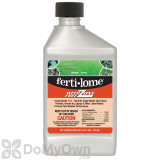
The active ingredient in Ferti-lome Weed Free Zone has been proven to kill Sticker Bur.
Yes Ferti-lome Weed Free Zone is labeled to kill poison ivy. It can be applied to newly seeded lawns after the 2nd mowing so that is it well established and will not be harmed. As long as this product is used according to the label, it is not harmful to pets. Make sure all pets are out of the area during treatment until the product has had time to dry. Once this product has dried it will not pose any threat to your pets.
Fertilome weed free zone will kill clover that is actively growing. Depending on where you are located and pre emergent you used, you may need to make another application with the pre emergent in the Spring.
You can reseed 2 weeks after application of Fertilome Weed Free Zone. Please refer to the product label for specific mixing and application instructions.
It is recommended not to mow within 2 days before or 2 days after applying Fertilome Weed Free Zone. You can water after 24 hours.
When applying Fertilome Weed Free Zone, you will start seeing results within 7-14 days.
Ferti-lome Weed Free Zone is best used when when soil temperatures are at least 55 degrees and the target weeds are young and actively growing. Do not use Ferti-lome Weed Free Zone when temperatures are above 90 degrees to avoid injury to your lawn.
The 32 oz bottle of Ferti-lome Weed Free Zone will cover up to 21,300 sq. ft.
Once Fertilome Weed Free Zone has been mixed with water, it should be used or discarded within 24 hours.
Ferti-lome Weed Free Zone is applied for spot applications at 0.75-1.5 fl oz per gallon of water for warm season grass and 1.5- 2 fl oz per gallon for cool season. Please refer to the product label for complete application and mixing instructions. Per the label, it can be used in Kentucky Bluegrass, Perennial Ryegrass, Tall Fescue, Red Fescue, Colonial Bentgrass, Common Bermuda Grass, Hybrid Bermuda Grass, Bahia Grass, Zoysia Grass, Buffalo Grass, St. Augustine and Centipede Grass.
Weed Free Zone should be stored in an area that does not pose temperatures below freezing or over 90 degrees. If stored in a cool, dry area, the shelf life is 3-5 years.
The mixing ratio for Fertilome Weed Free Zone is 1.5-2 fl. oz. per gallon of water. The mixing ratio for Hi-Yield Spreader Sticker is 2-4 teaspoons per gallon of water. You will set your Ortho Dial and Spray with the amount that coordinates to 1 gallon of water being mixed with the product.
It is recommended that you mow at least three times before applying Fertilome Weed Free Zone to a newly seeded lawn.
Fertilome Weed Free Zone is used to treat weeds that are actively emerging in a lawn and will not prevent new weeds from emerging. Monterey Vegetable and Ornamental Weeder is a pre-emergent herbicide that helps to control grasses and broadleaf weeds. This is one of the only products that is safe to use in vegetable gardens, and can also be used in flowers, trees, shrubs, groundcovers, and rock gardens. Vegetable and Ornamental Weeder will provide weed control for five months; simply apply to soil surface and water in.
It would not be recommended to use Ferti-lome Weed Free Zone actually states on the product label: Be particularly careful within dripline of trees and other ornamental species.
Ferti-lome Weed Free Zone would be the best option if you are just dealing with broadleaf weeds. Surflan AS is a pre-emergent only so will only prevent weeds from germinating, it does not do anything for actively growing weeds.
Since Ferti-lome Weed Free Zone is not labeled for use in grazing areas or around poultry houses, we would not recommend allowing chickens to enter the treated area if they will be feeding there or if the chickens or their eggs are going to be consumed.
Fertilome Weed Free Zone should NOT be applied to an area that has or will have vegetables/edibles. We would recommend that you treat with RoundUp QuikPro and wait two weeks to replant.
Fertilome Weed Free Zone should not harm bees as it is a herbicide only. To avoid any possible contact with bees, apply in the early morning or late evening when bees are less active.