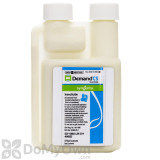
We are sorry to hear that your pet is sick. If you suspeect your pet is having a reaction to Demand CS, please contact the manufacturer Syngenta at 866-796-4368, as well as your pets Vet.
Demand CS is only labeled for outdoor use for fleas. If you are looking for a liquid concentrate to use indoors for fleas, we would recommend something like Onslaught. You may also want to take a look at our Flea Control Guide for more information.
Demand CS is safe for animals if applied according to the instructions on the product label. Animals need to be kept out of the area while the product is being applied. They can return once the product has completely dried.
Yes, Demand CS is labeled for carpenter ants and will kill any carpenter ants that come in contact with a treated surface. It is micro-encapsulated, so it works like a time released formula. For carpenter ant control specifically, we would recommend our Indoor Carpenter Ant Kit. The kit contains professional pest control products to control carpenter ants found inside structures, including two baits that contain different formulations and active ingredients to increase bait acceptance and efficacy. To control carpenter ants around the exterior of your home, Taurus SC will do the trick. You would mix 0.8 fl. oz. of Taurus SC per gallon of water and apply using a hand-pump sprayer around the outside of the home, spraying 1 foot up the side of the house and 1 foot out from the house, all the way around the home.
Demand CS should be mixed at 6-12 ml per one gallon of water per 1,000 sq ft per the product label, which is 3-6 mL or 0.1 – 0.4 oz per half gallon of water.
Demand CS has a shelf life of about 3 to 5 years when stored in a cool dry area. D-Fense Deltamethrin Dust has a shelf life of 3 years from the date of purchase.
Demand CS would be a great choice for general pest control for common insects found in and around the home. It can be applied every 90 days indoors and every 30 days outdoors. Termidor SC should ONLY be applied once every 6 months directly up against the structure on the exterior of foundation (1 ft up and 1 ft out). You should NOT apply Demand CS in the areas where you apply Termidor SC. Please refer to the product label prior to mixing and applying for complete usage instructions.
Termidor SC is applied only twice a year on the outside of the home depending on the rate used. Rotating it often with the Demand CS would null the non repellent factor of the Termidor. Most choose to use the Termidor outside and the Demand inside in cracks and crevices. Resistance can take years to build up.
Demand CS can last 60-90 days on outside surfaces so generally is applied once a quarter. If needed it can be applied as a spot treatment every 7 days per the product label.
Yes, Demand CS is labeled for clover mites. You will use 6-12 mL per gallon of water. Please refer to the product label for complete application instructions.
Yes, Nyguard IGR and Demand CS can be mixed and used together. You will use 0.2-0.8 oz. of Demand and 4-12 mL of Nyguard per gallon of water, depending on what pest(s) you are treating for. Typically one gallon of mixed solution will cover about 1000 sq. ft.
Keep in mind that Demand CS and other pyrethroids should not be sprayed over the entire surface of a deck or other hard surface. Keep to perimeter treatments and spot treatments where target insects are found.
If you plan to clean an area where you are going to spray a residual insecticide such as Demand CS, then it would be best to do your cleaning first and then apply the insecticide. This will not only ensure that you are spraying on the actual suface (rather than on top of dust/debris), but it will also prevent unecessary removal of your insecticide. Mopping or other abrasive cleaning will remove most if not all of your residual, so do these treatments before spraying for best results.
Keep in mind that Demand CS and other pyrethroids should not be sprayed over the entire surface of a deck or other hard surface. Keep to perimeter treatments and spot treatments where target insects are found.
Demand CS can be applied indoors to cracks and crevices and other locations listed on the product label.
Demand CS dries clear when used as directed and will not stain.
Demand CS is not labeled for grubs but we do offer products that are effective. Demand CS is listed for flying and crawling insects. Please take a few moments to review our article on How to Get Rid of Grubs for the best results. You would treat the flying and crawling insects with either Demand CS or Talstar P. Talstar P is not labeled for grubs also.
When applying ImidaPro 2SC for grub control, it is important to use sufficient water when applying to move the active ingredient through the thatch layer of grass into the soil where the insects will be or are feeding as soon as possible. This is usually an extra 1/4 inch to 1/2 inch of rainfall or irrigation with the application. As long as you do not have excessive rainfall while the application is still wet, and/or the ground is not saturated, then you should have residual activity for several weeks following the application.
To control White grub larvae, (such as Japanese beetle larvae, Chafers, Phyllophaga spp., Asiatic garden beetle, Oriental beetle) apply 0.46 to 0.6 fluid ounces (14 to 17 mL) per 1,000 sq. ft. Make broadcast applications by mixing specified rate in enough water to uniformly cover the treated area. Do not use less than 2 gallons of water per 1,000 sq. ft. Please refer to the product label for complete application instructions.
Demand CS should be applied when pets are not present and completely dry prior to their return to those treated areas. The product will not reactivate after that to be harmful to them.
Both Talstar P and Demand CS are labeled for a wide variety of insect pests and either would work well for general pest control. However, if spiders are a concern, or if you will be treating mainly outdoors, it would be better to choose a microencapsulated insecticide such as Demand CS. Microencapsulated products will hold up better outdoors, and their larger particle size makes them easier for larger insects like spiders and scorpions to pick up on their bodies.