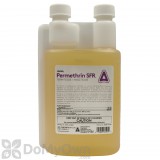
Permethrin SFR 36.8% can be applied to cattle. For treating flies/lice, you will apply 4 fl oz per 2 1/2 gallons of low pressure spray or 1/2 fl oz per ear for ear tick. It can also be applied at the rate of 4 oz per 25 gallon (treats 50-100 heads). For scabies, mange, lice and ticks you will wet the animal thoroughly and repeat applications in 10-14 days. For a backrubber/self oiler, you will add 4 fl oz to 10 gallons of diesel oil or suitable mineral oil. Please refer to Pages 47 & 48 on the product label for specific mixing and application instructions prior to use.
When using Permethrin SFR 36.8% for mole crickets the product label states you use 0.4 – 0.8 fl. oz. of Permethrin SFR in 4 to 25 gallons of water per 1000 square feet. Use the higher rate for fast knockdown and increased residual control. If you’re using the higher rate of 0.8 oz per 1000 sq ft, that would require 35.2 ounces for an acre. Dense or excessive (greater than 3 inches) lawn height and arid conditions may require higher volume application rates. Repeat application if necessary. Application in combination with compatible surfactants or wetting agents may enhance penetration.
We would recommend using Permethrin SFR 36.8% at the rate of 1 2/3 oz. per gallon water for ticks. It would also be a good idea to incorporate an insect growth regulator (IGR) such as Archer IGR for complete control of ticks. All of these products are pet safe if used as directed. Pets need to be kept out of the area being treated during application and until everything is completely dry.
Please look over our Tick Control Guide for more information on treating and preventing this pest.
We get asked about both of these applications for Permethrin SFR 36.8% frequently so are providing upfront information to better inform customers that they are not intended uses of the product. It can be used on lawns for the listed insects as indicated on the product label and only for mosquitoes in livestock premises.
Permethrin SFR 36.8% can be used around the perimeter and edges of the patio to kill those that contact a treated surface but there is not a true repellent that could be used to keep them away. Since sawyer beetles bore into dead or dying trees you should inspect trees, especially conifers, for any damage and have those infested cut down and the wood chipped or burned to eliminate areas that can draw them in.
No, Permethrin SFR 36.8% cannot be used in a fogger/mister. This product should only be used in a pump sprayer. We sugest using a product such as Talstar for misting.
Permethrin SFR 36.8% is not labeled for scabies so we cannot recommend it be used. Scabies mites live on/in the skin and we do not carry anything to treat humans. Most folks need to visit their doctor to receive the medication needed to get rid of scabies. You may spray your furniture with a product such as Steri-Fab to kill anything on furniture, though treating the home is usually not necessary.
In most cases, Permethrin SFR 36.8% is applied every 90 days indoors. Please see the product label for complete application instructions.
Permethrin SFR is labeled for chinch bug treatments in your lawn. Per the product label, you use 0.4 to 0.8 oz per 1000 sq ft in 4 -25 gallons of water. You want to be sure to use enough water to get the product below the thatch layer when dealing with chinch bugs.
Per the product label, when treating for termites, you will use the 0.5% solution rate, which is 1 2/3 oz. of Permethrin SFR per gallon of water. Please refer to the label for complete application instructions.
Permethrin SFR 36.8% is a synthetic pyrethrin like bifenthrin so they would work comparably. Dominion 2L would be a good option to use for chinch bug control and is a neonicotinoid and systemic so is absorbed by the roots that these bugs feed on. Best applied before they are active so it has time to be absorbed.
Permethrin SFR 36.8% is not specfically labeled for clover mites. Bifen IT would be a better option.
Permethrin SFR 36.8% would be mixed at the rate of 1 2/3 fl oz per gallon of water.
Permethrin SFR 36.8% would be safe around feeders as long as you are not spraying them directly. We would recommend applying when hummingbirds are not in the area so the chance of contact is less likely to occur.
We recommend using 1 2/3 fl. oz of Permethrin SFR 36.8% per gallon of water for ant mounds.The label recommends that you treat each by applying 1-2 gallons of emulsion to each mound area by sprinkling the mound until it is wet and treat a 4 foot diameter circle around the mound so the ants do not move their mounds. Use the higher volume for mounds larger than 12". For best results, apply in cool weather, such as in early morning or late evening hours, but not in the heat of the day.
Permethrin SFR 36.8% is safe to be used if you have pets as long as it is used according to the label instructions. You have to keep everyone including pets and children out of the treated area until it has completely dried.
Permethrin SFR would have limited results on cicada killer wasps as would any liquid application.
Dusting the holes with something like Tempo 1% Dust will allow it to flow through the nest better than a liquidMany of our customers have used Delta Gard Granules to help limit the number of cicada killers in their yard with some success. Still, the only surefire way to get rid of them is to treat the individual burrows.
Cicada Killer wasps thrive in disturbed environments, such as landscaped yards and places where bare soil is exposed. You can discourage the wasps from nesting in your yard by cutting your grass on the highest setting and by adding a thick layer of mulch to flower beds during the Cicada Killer Wasp season. These wasps do not like over saturated lawns either, so over watering during their season will help prevent them.
We also like to let our customers know that the Cicada Killer wasps are beneficial insects that provide free pest control for a couple months each year. Cicada killer wasps paralyze and provision their burrows with other insects to feed their young. The beneficial Cicada killer wasps, while large and intimidating to see, are mostly harmless and there have been very few reports of anyone getting stung by just being near them. In most cases where a sting was reported, the wasps were being held or molested in some way. Cicada Killer Wasp stings are also reported to be almost painless.