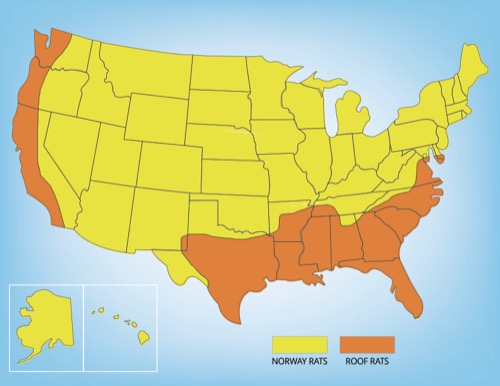





Two Main Types of Rats in the U.S.


Rats are one of the most damaging pests in the United States. They cause trouble by contaminating food products, nesting and gnawing on structures, and spreading parasites and diseases to humans and domesticated animals. There are two main types of rats that infest structures in the United States, roof rats and Norway rats. Both species of rats are highly adaptable, and they can be found in a wide range of residential, agricultural, and industrial structures and areas.
Continue reading to learn more about how to identify rats, or click on one of the topics below to learn more about them.
Rats or Mice?
If you're seeing droppings, hearing scratching in the walls, or spotting something dart across the floor, it's important to know whether you're dealing with rats or mice before you choose a treatment. Rats and mice differ in size, color, and some treatment types. Learn the difference before you choose a treatment plan.
Rat Lifecycle
Understanding the rat lifecycle is key to a successful treatment plan. You may be wondering how long do rats live? Adult rats can live for about 1-3 years.
Females can reach breeding age within 2 months, but usually start reproducing at around 5-6 months. The gestation period for rats lasts about 21-25 days, and a female usually produces 6-13 pups (rat babies). Rats can typically produce 5-10 litters per year.

How big are rats?
- Roof rats range in weight from 5-10 ounces
- Roof rats range in length from 10 -12 inches long
- Roof rats are sleek of build
- The tail of a roof rat, pulled over the body, will typically reach the nose
- Norway rats range in weight from 7-18 ounces
- Norway rats range in length from 13-18 inches long
- Norway rats are larger in build and more robust
- The tail of a Norway rat, pulled over the body, will only reach the ears
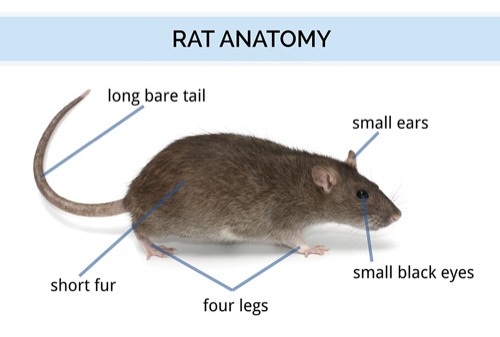
- Rats have 4 legs
- Rats have short fur
- Rats have tails that vary in length but are generally not hairy
- Rats have beady black eyes
- Rats have two small ears
Do rats have bones?
While rats can squeeze their way into very small spaces, they do have bones.Do rats have bladders?
While rats do frequently urinate, seemingly uncontrollably, they do have bladders.