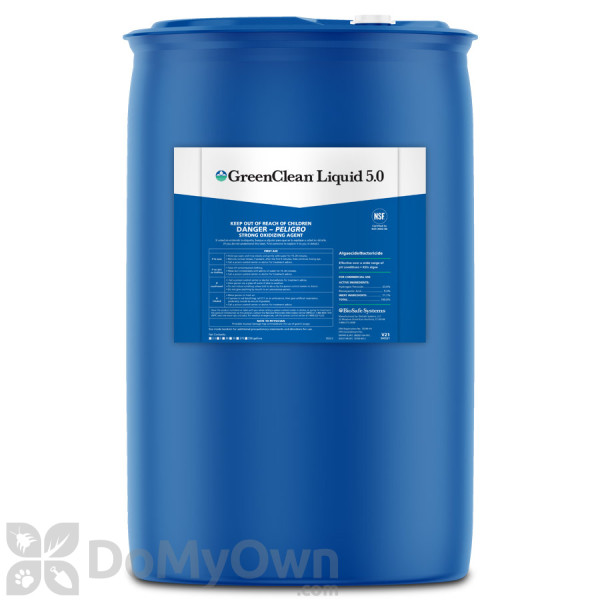
GreenClean Liquid 5.0 Algaecide, Fungicide, and Bactericide
Price/Ea.
$190.12
Have a Question? Ask Our Pros!
Email Our Pros
We're here to help
Offline. Leave Us a Message
You May Also Need
-
Product Overview
GreenClean Liquid 5.0 is a selective and effective formulation used for fast-acting control of algae and cyanobacteria. This OMRI-listed product is a reduced-risk, sustainable chemistry with minimal impact on non-target organisms. It is great alternative to copper algaecides and can be used as a tank mix partner with other compatible algaecides for enhanced algae control. GreenClean Liquid 5.0 is effective for a wide range of water qualities and pH conditions, and it releases vital oxygen into the water as it degrades over time. Use for water treatment in areas like lakes, ponds, water gardens, lagoons, fountains, bird baths, and catch basins (see label for a complete list of use sites).
-
Details
Active Ingredient 23.0% Hydrogen Peroxide 5.3% Peroxyacectic Acide Target pests Cyanobacteria and algae For use in Ponds, Lakes, Lagoons, Bird Baths, Reservoirs, Waterways, Canals, Laterals, Drainage Systems, Catch Basins, Sewage Systems, and Tanks Application Apply GreenClean Liquid 5.0 at the rate of 2.8-28.5 gallons per acre-ft of water. Use higher rates when existing algae density is high (algae blooms) and/or when dealing with resistant algae types. See label for complete directions. Pet safe Yes, if used as directed NOT FOR SALE TO AK, PR
CT, ME (Restricted To Licensed Applicators Only)Dimensions 9.50 x 9.50 x 15.50 Shipping Weight 46.75 lbs Manufacturer BioSafe Systems EPA Registration 70299-19 ENVIRONMENTAL HAZARDS
This product is highly toxic to bees and other beneficial insects exposed to direct contact on blooming crops or weeds. Do not apply this product or allow it to drift to blooming crops or weeds while bees are actively visiting the treatment area. Do not apply this product or allow it to drift to crops where beneficials are part of an Integrated Pest Management strategy.
This pesticide is toxic to fish. Begin treatment along the shore and proceed outward in bands to allow fish to move intO untreated areas. Consult with the State agency with primary responsibility for regulating pesticides before applying to public waters to determine if a permit is needed.
This pesticide is toxic to birds. Treated seed exposed on soil surface may be harmful to birds.
Do not apply directly to treated, finished drinking water reservoirs or drinking water receptacles when the water is intended for human consumption. Do not contaminate water when disposing of equipment washwater or rinsate.
PHYSICAL AND CHEMICAL HAZARDS
STRONG OXIDIZING AGENT. Corrosive. Do not use in concentrated form. Mix only with water in accordance with label instructions. Never bring concentrate in contact with other pesticides, cleaners or oxidative agents.
STORAGE AND DISPOSAL
Do not contaminate water, food, or feed by storage or disposal.
PESTICIDE STORAGE: Store in original container in a cool, dry well-vented area, away from direct sunlight. Do not allow product to become overheated in storage. Do not store in a manner where cross-contamination with other pesticides or fertilizers could occur.PESTICIDE DISPOSAL: Pesticide wastes are acutely hazardous. Improper disposal of excess pesticide, spray mixture, or rinsate is a violation of Federal Law. If these wastes cannot be disposed of by use according to label directions, contact your State Pesticide or Environmental Control Agency, or the Hazardous Waste Representative at the nearest EPA Regional Office for guidance.
-
Product Documents
-
Customer Reviews
-
Questions & Answers