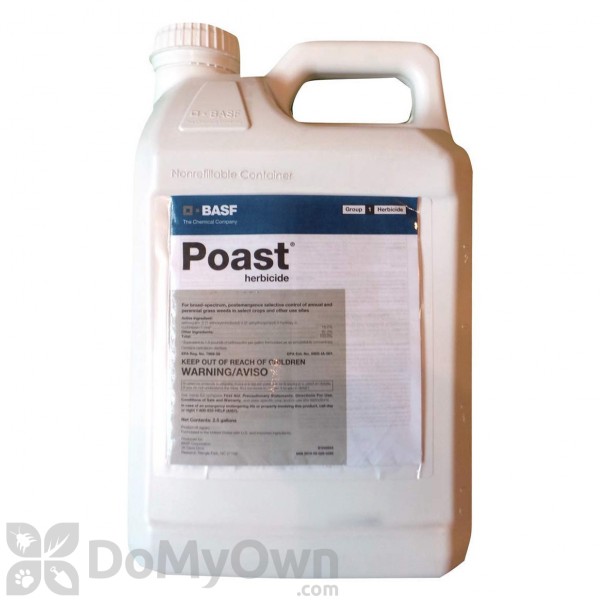
Poast Herbicide
Price/Ea.
$327.83
Buy 2 or more: $324.89 each
Have a Question? Ask Our Pros!
Email Our Pros
We're here to help
Offline. Leave Us a Message
You May Also Need
-
Product Overview
Poast Herbicide affects the lipid synthesis by inhibition of Acetyl CoA Carboxylase (ACCase) in plants. It belongs to herbicide mode-of-action Group 1. Lipids are an important component in cell division and plant growth. If plant cells cannot divide, the plant will die.
Poast rapidly enters the target grass weed through its foliage and moves throughout the plant. Effects range from slowing or stopping growth (typically within 2 days) to foliage reddening and leaf tip burn. Foliage burnback may occur later. Symptoms are typically observed within 3 weeks of application of Poast, depending on environmental conditions.
-
Details
Active Ingredient Sethoxydim 18% Target pests Barnyard-grass, Crabgrass (Large & Smooth), Cup-grass, Fescue (Tall), Foxtail, Goose-grass, Rye-grass, Witch-grass, Bermuda-grass and others
* See Label for complete listFor use in Alfalfa, Asparagus, Blueberry, Carrot, Clover, Corn, Flax, Grape, Horseradish, Leafy Vegetables, Peach, Peanut, Potato, Strawberry, Tobacco, Tomato, Tree Nuts and others
* See Label for complete listApplication * See Label for complete application instructions Pet safe Yes, if used as directed on Label Formulation Professional Product
Group 1 HerbicideNOT FOR SALE TO AK, ME
VT (Restricted To Licensed Applicators Only)Shipping Weight 21.00 lbs Manufacturer BASF EPA Registration 7969-58 Application Instructions
Apply Poast herbicide to actively growing grass weeds by aerial or ground application at the rates and timing (maximum height) listed (annual grass weeds), (perennial grass weeds), and (early and rescue treatments to control select annual grass weeds), as instructed in the Use-specific Information section of this label. For small area application or spot application, refer to Label.
NOTE:
The most effective control will be achieved by applying post-emergence applications of Poast early in the growing season, when grass weeds are small. Poast may not be effective on grass weeds that have grown taller than the maximum heights listed.
-
Product Documents
-
-
Customer Reviews
-
13 Questions & Answers
Helpful Q&A'sQCan I use Poast Herbicide safely to kill grass in a asparagus bed?Have an asparagus bed that's getting pretty infested with grass, and want to kill the grass but keep the asparagus! Will this do the trick?APoast Herbicide is labeled to be used on asparagus as directed on the label and would not harm it.
QIs Poast safe to use on centipede/St. Augustine grass?APoast is actually a grass killer, so it would not be safe to use on centipede or St. Augustine grass.
QCan Poast Herbicide be used around raspberries and blackberry plantings?AYes, Poast Herbicide does list both raspberry and blackberry on the product label. The maximum single application rate is 2.5 pints/acre and the maximum annual application rate is 5 pints/acre. Gra…
Read Full Answer »Yes, Poast Herbicide does list both raspberry and blackberry on the product label. The maximum single application rate is 2.5 pints/acre and the maximum annual application rate is 5 pints/acre. Grassy weed application rates and timing (maximum height) are based on growing regions as described in the Regional Descriptions on page 8 of the product label. You will need to identify if you are located in Region 1 or Region 2, then refer Table 5 on page 10 of the product label for the Application Rates, Height of Weeds and Timing for Annual and Perennial Weeds.