

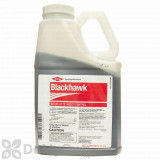
Blackhawk Insecticide


Price/Ea.
$890.91
Buy 2 or more: $888.57 each
Have a Question? Ask Our Pros!
Email Our Pros
We're here to help
Offline. Leave Us a Message
You May Also Need
-
Product Overview
Blackhawk Insecticide is specially and uniquely formulated to control various foliage feeding pests. Contains Spinosad as its active ingredient, making it highly effective in killing and controlling insects. It fights and eliminates insects including caterpillar, moth, peanut worm, earworm, corn borer, budworm, beetle, leafminer, hornworm, grasshopper, webworm, flea beetle. thrips, and psyllid. The Blackhawk Insecticide features an excellent residual control and unique mode of action, making it an excellent fit for Integrated Pest Management programs. It is proven to be fast-acting because it delivers immediate knockdown of insect pests once applied while being gentle on beneficial insects. May be applied on crops such as beans, carrots, corn, cotton, ginger, ginseng, grass, oat, parsnip, pea, peanut, potato, radish, tobacco, soybean, and sorghum. Available in a 64-oz container.
-
Details
Active Ingredient Spinosad - 36% Target pests Armyworm, Beetle, Bollworm, Budworm, Caterpillar, Corn Borer, Cutworm, Earworm, Fleabeetle, Grasshopper, Hornworm, Leafminer, Leafperforator, Looper, Moth, Peanut worm, Podworm, Psyllid, Thrips, Webworm. For use in Amaranth, Arracacha, Arrowroot, Artichoke, Barley, Bean, Beet, Buckwheat, Burdock, Canna, Carrot, Cassava, Celeriac Celery Root, Cereal Grains, Corn, Cotton, Ginger, Ginseng, Grass, Oat, Parsley, Parsnip, Pea, Peanut, Potato, Radish. Application Fill the spray tank with water to about one-half of the required spray volume. Start agitation and add the required amount of Blackhawk. Continue agitation while mixing and filling the spray tank to the required spray volume. Pet safe Yes, if used as directed on the label. Formulation Liquid formula. NOT FOR SALE TO AK, AZ, CA, FL, HI Special Features Provides quick knockdown of targeted pests with good residual control, and maintains populations of beneficial insects. Shipping Weight 4.59 lbs Manufacturer Corteva Agriscience EPA Registration 62719-523 Mixing Directions
Blackhawk - Alone: Fill the spray tank with water to about one-half of the required spray volume. Start agitation and add the required amount of Blackhawk. Continue agitation while mixing and filling the spray tank to the required spray volume. Maintain sufficient agitation during application to ensure uniformity of the spray mix. Do not allow water or spray mixture to back-siphon into the water source.
Blackhawk - Tank Mix: When tank mixing Blackhawk with other materials, conduct a compatibility test (jar test) using relative proportions of the tank mix ingredients prior to mixing ingredients in the spray tank. If foliar fertilizers are used, repeat the jar test with each batch of fertilizer utilizing the mixing water source. Vigorous, continuous agitation during mixing, filling and throughout the application is required for all tank mixes. Sparger pipe agitators generally provide the most effective agitation in spray tanks. To prevent foaming in the spray tank, avoid stirring or splashing air into the spray mixture.
Mixing Order for Tank Mixes: Fill the spray tank with water to 1/4 to 1/3 of the required spray volume. Start agitation. Add different formulation types in the order indicated below, allowing time for complete dispersion and mixing after the addition of each product. Allow extra dispersion and mixing time for dry flowable products.
Add different formulation types in the following order:
1. Blackhawk and other water dispersible granules
2. Wettable powders
Maintain agitation and fill spray tank to 3/4 of total spray volume. Then add:
3. Emulsifiable concentrates and water-based solutions
4. Spray adjuvants, surfactants, and oils
5. Foliar fertilizers
Finish filling the spray tank. Maintain continuous agitation during mixing, final filling and throughout the application. If spraying and agitation must be stopped before the spray tank is empty, the materials may settle to the bottom. Settled materials must be resuspended before spraying is resumed. A sparger agitator is particularly useful for this purpose.
Premixing: Dry and flowable formulations may be premixed with water (slurried) and added to the spray tank through a 20 to 35 mesh screen. This procedure assures good initial dispersion of these formulation types.
Spray Tank pH: A spray tank pH between 6.0 and 9.0 is suggested to achieve maximum performance of Blackhawk. If the water source is outside of this pH range, or tank mixing other pesticides, adjuvants, or foliar nutrients will cause the pH to fall outside this range, consider adjusting the spray tank pH to be between 6.0 and 9.0 before adding Blackhawk. To do this, add all other tank mix components first, then check the spray tank pH, adjust if desired, and then add Blackhawk. If you require additional information on how to adjust spray tank pH, contact your Dow AgroSciences representative.
Application Directions
Applications to greenhouses or other enclosed structures are limited to ornamental uses.
Proper application techniques help ensure thorough spray coverage and correct dosage for optimum insect control. The following directions are provided for ground and aerial application of Blackhawk. Attention should be given to sprayer speed and calibration, wind speed, and foliar canopy to ensure adequate spray coverage.
Uses
Corn (Field, Sweet, Popcorn, Seed Corn) and Teosinte
Pests and Application Rates:
- European corn borer, fall armyworm, true armyworm
- 1.67 – 3.3 oz/acre
- beet armyworm, corn earworm, southwestern corn borer, western bean cutworm
- 2.2 – 3.3 oz/acre
Cotton
Pests and Application Rates:
- cotton bollworm (pre-bloom), cotton leaf perforator, European corn borer, tobacco budworm
- 1.6 – 3.2 oz/acre
- armyworms, cotton bollworm (post-bloom), leafminers, loopers, saltmarsh caterpillar, thrips
- 2.4 – 3.2 oz/acre
Grass Crops, Grass Grown for Seed, Pastures, Rangeland and Sod Farms
Pests and Application Rates:
- beet armyworm, fall armyworm, sod webworms, southern armyworm, true armyworm, other lepidopterous species
- 1.1 – 2.2 oz/acre
Legume Vegetables (Succulent and Dried Beans and Peas) (Crop Group 6)
Pests and Application Rates:
- European corn borer (eggs and larvae)
- 1.7 – 3.3 oz/acre
- armyworms, corn earworm, loopers
- 2.2 – 3.3 oz/acre
- leafminers, thrips
- 2.5 – 3.3 oz/acre
*See label for the complete list of pests and application rates.
- European corn borer, fall armyworm, true armyworm
-
Product Documents
-
Customer Reviews
-
Questions & Answers