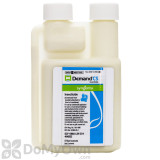
We would recommend contacting the manufacturer of Demand CS directly to see if it would be advisable to plant anything in the area that was treated, or the best method to remove the product from the soil, if possible. You can reach Syngenta at 866-796-4368.
You can use either Cy-Kick CS or Demand CS in a Solo 451 Backpack Sprayer. For Demand CS, use 0.2 - 0.8 fl. oz. of concentrate per gallon of water or per 1,000 square feet. Keep in mind that a mist blower like the Solo will apply product very quickly, so be sure you are using correct use rates when applying product over large areas. You should also be sure to follow all label directions and precautions, such as applying when conditions are calm.
Yes, Demand CS is applied to lawns at the rate of 7ml per 1,000 sq ft. Treatments for chiggers should begin in May and could need to continue through the summer as new chiggers move into the area. Treating the entire lawn is of little benefit because chiggers avoid direct sunlight and normally will not infest areas that are mowed or otherwise well maintained. Focus treatment on the unkempt areas of the lawn and lawn edge. You can also use Demand CS to do a barrier treatment around the outside of your home and in your crawl space to stop pests from moving indoors.
Demand CS should be applied when there is no rain the forecast for 24 hours after application. The outdoor residual of the product is up to 30 days. Heavy or prolonged rains can diminish that residual slightly.
It is not usually required to use a surfactant with Demand CS.
Demand CS is not a systemic. As in, it will not leach into soil. It does not leach into soil like Imidicloprid products.
If back spray or drift for a Demand CS application were to get on any edibles, fruits or vegetables, they would need to be discarded and not consumed.
Demand CS is a residual insecticide that will continue to kill the labeled insects for an extented period of time. However it is not a contact kill product. It can sometimes take a few days before you start to see dead insects after making an application of the product.
Demand CS is safe for animals if applied according to the instructions on the product label. Animals need to be kept out of the area while the product is being applied. They can return once the product has completely dried.
Biting midges do generally not enter structures, but midges are small enough to get through 16 mesh screens. Getting mesh screens with a higher number can keep these and other very tiny insects out of your home. Our experts recommend using a pyrethrin spray such as 565 Plus or Microcare to get rid of the adult midges in or around your home.
Non-biting midges are attracted to lights, so it is recommended to draw your shades at night and wait as long as possible to turn on exterior lights to keep them away from your home. Using the FlyWeb Fly Light inside the home works great on flying insects inside the home.
A great prodcut to use indoors and outdoors on your home that is safe for pets and kids once it has dried it called Onslaught. Onslaught can be used as a broadcast over carpeted areas inside the home mixing at 1oz per gallon of water. Spraying a product such as Onslaught on window screens, doors, bushes, and plants around your home can act as midge repellant to keep midges away.

Demand CS is labeled for a variety of insects, including Asian Beetles. The key is to treat early enough (early fall) and to apply the product in the right places. Asian beetles enter the structure through cracks and crevices, especially around windows and doors. Be sure to treat these areas thoroughly once a month through November. Please click on the product label for detailed instructions on application.
Per the manufacturer it is recommended to use anywhere from 0.2 to 0.8 oz/6 to 24 ml per gallon of water. If you need to make 50 gallons of mixed solution you would use 10-40 ounces of Demand CS for 50 gallons. Always follow the product label provided by the manufactuer.
Yes, you can mix Demand CS and an IGR such as Gentrol in the same tank at the same time. You would clean your equipment with water and a tank cleaner, if needed.
Spring is the best time to treat to try and grasp better control of the moths. If temps are above 50 degrees now, you can try and use Dormant Oil. This will suffocate them once they come in contact with the solution. Malathion would be a great product to use in the Spring to treat the eggs.