
Buy 2 or more: $16.96 each
Have a Question? Ask Our Pros!
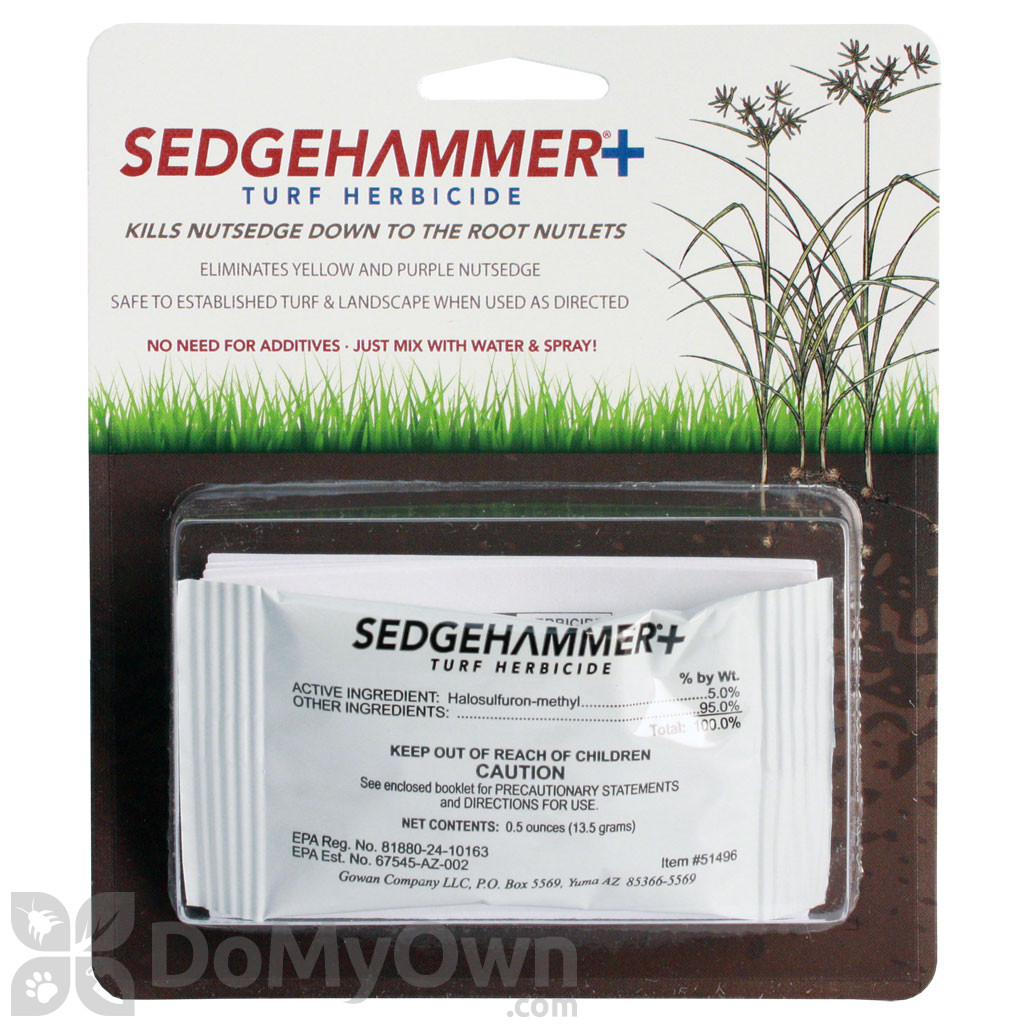
SedgeHammer + Herbicide kills nutsedge without injury to turfgrass, established ornamentals, shrubs, and/or trees. SedgeHammer Plus (+) provides post-emergence control of both purple nutsedge and yellow nutsedge. This nutsedge killer herbicide also controls many broadleaf weeds and suppresses kyllinga. Nutsedge is controlled after emergence in cool and warm season turf grasses such as St. Augustinegrass, Bermudagrass, Kentucky Bluegrass, tall and fine fescue, and perennial ryegrass. Sedgehammer + is considered one of the more "gentle to turfgrass" nutsedge killers and pets and people can return to the treated area once the spray dries.
The “+” (plus) in SedgeHammer + indicates that it already contains a non-ionic surfactant. This saves you time and money – no additional product is needed and no extra time spent mixing in additional product. The surfact helps the Sedgehammer Plus spray spread across and penetrate into the waxy leaves of nutsedge more easily. The surfactant also helps with water dispersion, ensuring the spray is even across the leaf for absorption into the vascular system of the plant.
Product Features:
Each 13.5 gram packet will treat 1,000 sq. ft.
For larger areas, consider using SedgeHammer Herbicide in the 1.33 oz. bottle, which treats up to 40,000 sq. ft.
Product Documents
| Active Ingredient | Halosulfuron-methyl 5% |
|---|---|
| Target pests | Purple Nutsedge, Yellow Nutsedge, Kyllinga |
| For use in |
Turfgrass, Landscaped areas, and other non-crop areas * See label for complete list |
| Application | Mix 1 packet in 1 gallon of water to cover 1000 sq. ft. |
| Yield | 1 packet covers 1000 sq ft. |
| NOT FOR SALE TO |
AK VT (Restricted To Licensed Applicators Only) |
| Shipping Weight | 0.06 lbs |
| Manufacturer | Gowan |
| UPC | 714654514980 |
| EPA Registration | 81880-24-10163 |
SedgeHammer + is a water-soluble granule formulation that is mixed with water and applied to target plants with a sprayer. SedgeHammer Plus nutsedge killer herbicide is a member of the sulfonylurea family, an ALS (acetolactate) enzyme inhibiting herbicide. The active ingredient is absorbed into leaf tissue as quickly as 24 to 48 hours after application, then translocated through the plant’s vascular system. The herbicide quickly inhibits amino acids, halting cell division and plant growth in both roots and shoots, causing eventual death in target plants.
Purple Nutsedge, Yellow Nutsedge, Kyllinga
WEEDS CONTROLLED WITH SEDGEHAMMER +: Purple Nutsedge, Yellow Nutsedge, Green Kyllinga, Annual Kyllinga, Cocklebur, common Sunflower, common Ragweed, giant Ragweed, Pigweed, Velvetleaf, Horsetail
Additional weeds controlled with SEDGEHAMMER+ (small packets) only: Burcucumber (suppression), Corn Spurry, Rice Flatsedge, Philadelphia fleabane, Galinsoga, common groundsel (preemergent only), Jimsonweed (preemergent only), Kochia (suppression), Ladysthumb, common Lambsquarter (preemergent only), Venice Mallow (suppression), common Milkweed (suppression), honeyvine Millkweed (suppression), Morningglory (suppression), wild Mustard, redroot Pigweed, smooth Pigweed, common Poweweed, Purslane (preemergent suppression), wild Radish, Shepherds purse (suppression), Pennsylvania Smartweed
SedgeHammer + Herbicide is a selective, post-emergent herbicide concentrate designed specifically to kill nutsedge and other broadleaf weeds without injury to turfgrasses, established ornamentals, shrubs, or trees. This nutsedge killer herbicide can be used in both warm-season and cool-season turfgrasses, landscaped areas, and other non-crop areas.
SedgeHammer + will not prevent germination of most labeled target weeds. Rather, it should be applied to actively growing weeds. If turfgrass or nutsedge is under stress, poor control may result. Also, desirable turfgrass, ornamentals, and trees should be well established before application. Do not apply to edible plants or gardens.
*Note that weeds can develop resistance to herbicides. To minimize the potential for resistance development and/or to control resistant weed biotypes, use a variety of cultural, mechanical, and chemical weed control tactics. Rotate with herbicides having other modes of action.
ACTIVE INGREDIENT: 13.5 g package – Halosulfuron-methyl 5%
SedgeHammer + is a powder concentrate to be diluted with water and applied with a pump sprayer. SedgeHammer Plus nutsedge killer should not be applied with hose-end sprayers since they are far less accurate than hand pump sprayers. When applying, spray the weeds thoroughly and wet the entire leaf surface of the undesirable plants. For best results, spray nutsedge after it has reached the 3 to 8 leaf stage of growth.
SedgeHammer + often works with one application, but depending on the size and age of the nutsedge a second treatment may be required 6 to 10 weeks after the initial treatment. See “Other Tips” below for more information.
The 13.5 gram packets already contain a surfactant, so you only need to mix the contents of the packet itself with a gallon of water. See below for further details. Always read the product label completely before use.
Each 13.5 g packet makes 1 gallon of finished solution and already contains a surfactant. Each gallon of finished solution covers approximately 1,000 square feet.
Standard Application Dilution rates / Mixing Ratios for SedgeHammer +:
*13.5 g packet – Entire contents of 1 packet (0.5 oz.) per gallon of water – Ideal for spot treatments. For treating larger areas, consider SedgeHammer Herbicide in the 1.33 oz. bottle.
Commercial and residential turf and other non-crop sites including: airports, cemeteries, fallow areas, golf courses, landscaped areas, public recreation areas, residential property, roadsides, school grounds, sports fields, landscaped areas with established woody ornamentals, fairgrounds, race tracks, tennis courts, campgrounds, and rights-of-way
Tolerant Turfgrasses – Cool-Season: creeping Bentgrass, Kentucky Bluegrass, fine Fescue, tall Fescue, perennial Ryegrass; Warm-Season: Bahiagrass, Bermudagrass, Buffalograss (Sedgehammer+ only), Centipedegrass, Seashore pasapalum, St. Augustinegrass, Kikuyugrass, Zoysiagrass
SedgeHammer + is not labeled for indoor use of any kind.
See general mixing instructions, mixing rates, and application details above.
Established woody ornamentals in landscaped areas – Apply as a post-directed spray. Avoid contact of this product to leaves of desirable plants since foliar injury, discoloration or death may result.
Horsetail Control – SedgeHammer + (small packets): Apply 1 oz. (27 g or 2 pouches) per 1,000 square feet after horsetail has leafed out. SedgeHammer (bottle): Apply 2 2/3 oz. per acre, or 1.8 g per 1,000 square feet.
This rate of product will control horsetail that is less than 6 inches tall and suppress horsetail that is greater than 6 inches tall. Herbicide symptoms are likely to show within 2 weeks as a necrotic ring at the base of the plant, even though the leaves and stems remain green and a deep leathery green in color.
Compare to: ProSedge Herbicide

It works!
By Charles on 06/20/2010
I've been fighting nutsedge for several years using nutsedge and crabgrass control products. They were disgustingly ineffective. I read of other people's experience with SedgeHammer on a daylily web page and decided to try it. Two days after spraying, the nutsedge started turning brown. Of equal importance, the daylilies surrounding it did not. They show no evidence of ever being near an herbicide. Am I satisfied? You bet!
Was this review helpful to you? YesNo
409 of 419 people found this review helpful
Sedgehammer - THE solution for nutsege
By Len on 09/02/2010
This hot, dry summer we've been having here in Tidewater, Virginia has been awful for the fescue we grow here but perfect for nutsedge. My infestation was extensive. A few tips: Follow all the advice given in the instructions. Make sure the nutsedge has almost a week of growth on it; this is important. If the sedge is too small or you try to use it on a freshly cut lawn, the sedge won't have enough surface area to absorb sufficient herbicide to be effective. Also, make sure you sure use surfactent with the hebicide, it will help this very expensive chemical be absorbed more effectively by the sedge. Give the chemical time to work; the longer you can wait before mowing after application (I waited almost a week before mowing) the better the killoff. By that time (a week after application) I had an almost 95% killoff, the few live sedges were those few I had missed on the first application. One more application on the stragglers will finish the job.
Was this review helpful to you? YesNo
314 of 319 people found this review helpful
Sedgehammer
By Gary on 07/16/2010
I hate nut grass. It has been a problem for me from my first yard. I have used Roundup with an eye dropper and even a hypodermic syringe to kill the stuff. Then a man recommended SedgeHammer. The price was a little frightening but my resolve was firm. I bought it from DoMyOwnPestControl.com, received it promptly and used it with great success. The yellow nut grass began dying in 3 days and now is gone. I don't know if it will remain "gone", but I have enough of the stuff to "kill" it repeatedly.
Was this review helpful to you? YesNo
231 of 240 people found this review helpful
SedgeHammer Works!
By Angela on 09/06/2010
Despite the fact that SedgeHammer is very expensive, I do not regret purchasing it because it WORKS! I bought the largest bottle which I think makes up to 40 gallons. So, I'll have enough to last me a few years. I recommend using an herbicide pump sprayer. I bought a Round-Up brand 2-gallon sprayer for $20 and it allows me to not waste as much SedgeHammer as I would if I used a watering can. I had A LOT of well-established sedge. About 7-10 days after the first application the sedge turned yellow and stopped growing and the grass was NOT harmed. I just did a second application because I had missed a lot sedge plants during the first application. This product is worth the $$.
Was this review helpful to you? YesNo
189 of 198 people found this review helpful

The Sedge Gets Hammered
By Dennis on 07/07/2010
I have been using this product for several years, and have found it to be the most effective for control of sedge, particularly in beds and around ornamentals in combination with Roundup. Because I am blessed with rich soil, everything grows well - sedge too; so control of sedge is an ongoing battle. The granular form of the product is convenient and easy to measure with the included measuring spoon.
Was this review helpful to you? YesNo
135 of 145 people found this review helpful
My Sedgehammer order arrived while I was away. Consequently it was exposed to freezing temperatures for a few days. Is it harmed?
We've had a warm winter in Pennsylvania and the sedge has popped up in mid-February and is actively growing. It's been in the 40s and 50s, but the night temperatures are around freezing many nights. Can I apply it now or is that a waste? Should I wait until at least it isn't freezing at night?
Stored in garage that ranges from 38 degrees F to maybe 88 in summer months in TN thanks!
SedgeHammer Herbicide has a shelf life of about 5 – 7 years if kept out of extreme temperatures and direct sunlight. Nothing below freezing or above 90. Typically it is best kept in a cool dry place inside.
Was this answer helpful to you? YesNo
12 of 13 people found this answer helpful
SedgeHammer Herbicide is not labeled for clover or creeping charlie.
Was this answer helpful to you? YesNo
1 of 2 people found this answer helpful
SedgeHammer Herbicide can be applied to fine and tall fescue, creeping bentgrass, kentucky bluegrass and perennial ryegrass.
Was this answer helpful to you? YesNo
4 of 5 people found this answer helpful
Miami Fl area
For nutsedge control it is best treated using something like Sedgehammer Herbicide which is specifically designed for it and is also for some other broadleaf weeds. For signal grass is it best treated with a pre-emergent like Prodiamine 65 WDG but complete control is not always possible with this weed as it is a very difficult weed to control. You could also spot treat with a glyphosate based product like GlyPhoSel Pro and then reseed/so the area. The University of Florida has some information here about.
Was this answer helpful to you? YesNo
5 of 6 people found this answer helpful
Also how much does the largest bottle make when mixed?
SedgeHammer Herbicide should not be used on pastures or grazing areas, and you should not treat around hay that will be used for animal feed. The SedgeHammer should not affect Timothy grass that may be contacted by the herbicide, although the product label does not specify information about this plant, so we would recommend spot treating a small area first before applying over a large area with this plant. The 1.33 oz bottle of SedgeHammer will yield about 40 gallons of finished solution. You should add 2 teaspoons of a non-ionic surfactant per gallon of water when diluting SedgeHammer from the larger bottle. The smaller packets already have a surfactant mixed in with the product.
Was this answer helpful to you? YesNo
4 of 4 people found this answer helpful
Items 1 - 7 (of 7 Total)
SedgeHammer Plus Herbicide
 Rating: 4.5 (835 Reviews / 295 Q&A)